GPT-5.5 Instant 2026: What Changed in ChatGPT
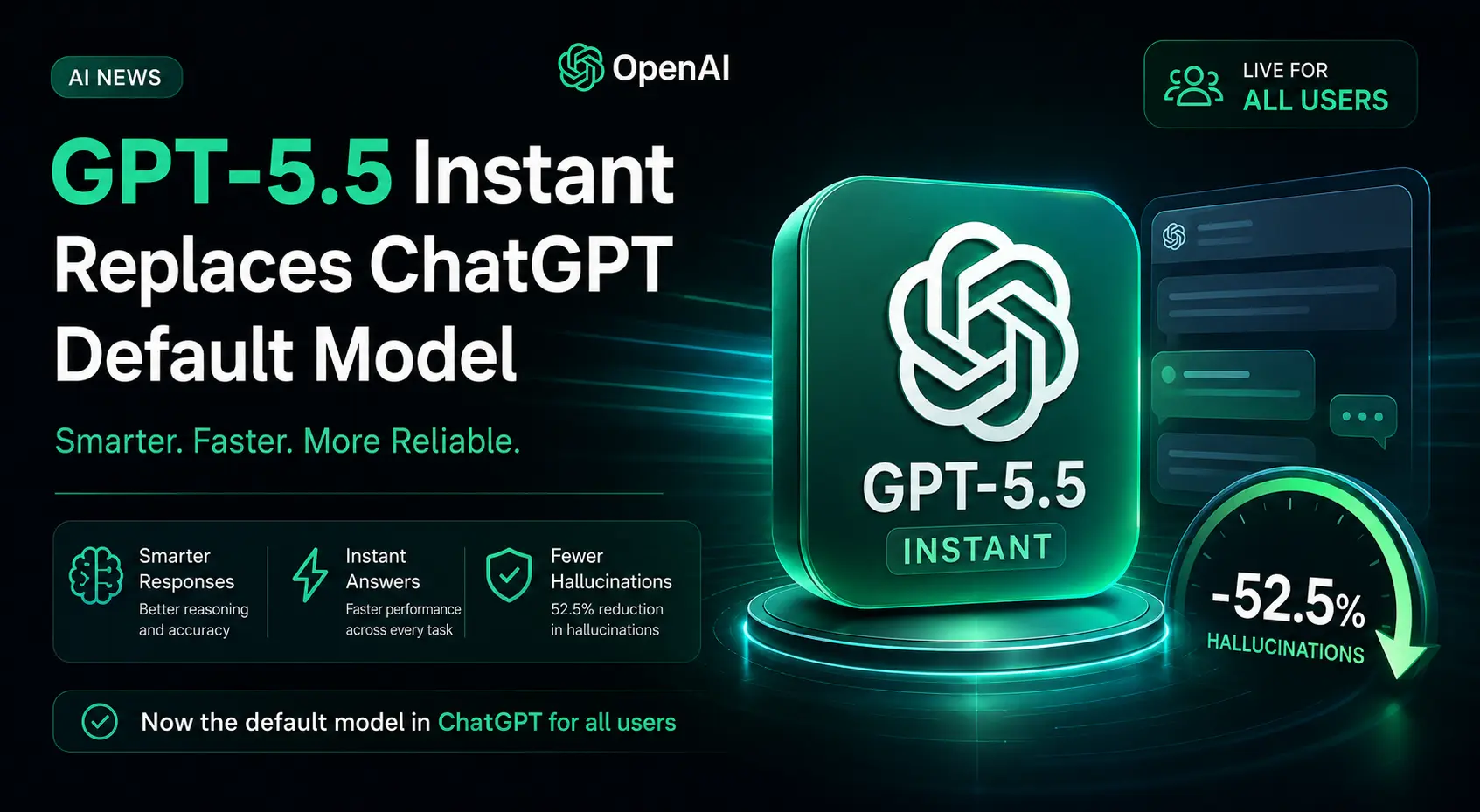
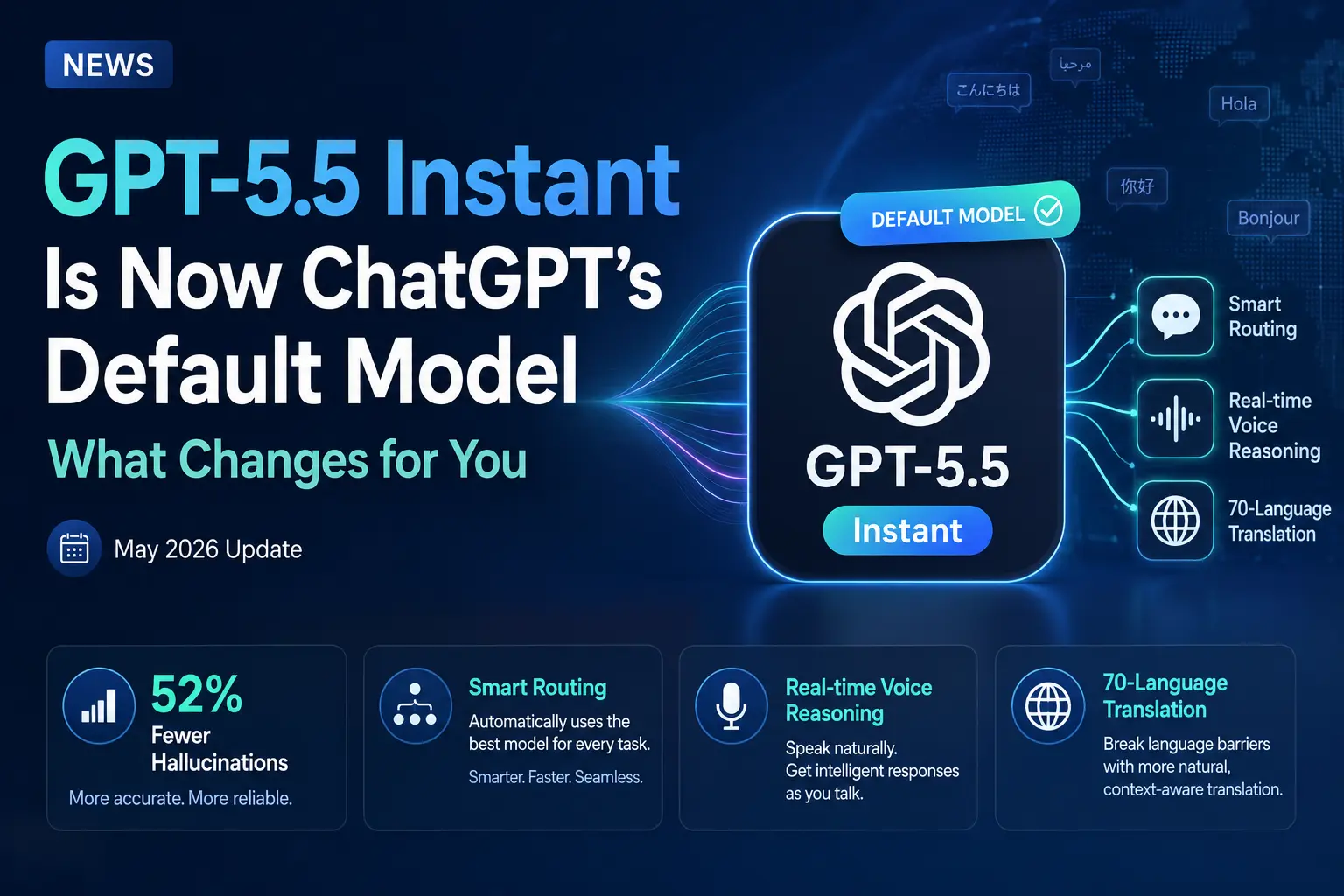
GPT-5.5 Instant is the default ChatGPT model for logged-in users, with more concise answers, stronger factuality, automatic routing to GPT-5.5 Thinking, and improved personalization controls. OpenAI reports 52.5% fewer hallucinated claims than GPT-5.3 Instant in its internal high-stakes evaluations, but important medical, legal, financial, and business claims still need verification.
Quick answer: what changed with GPT-5.5 Instant?
Most users do not need to change a setting. GPT-5.5 Instant replaced GPT-5.3 Instant as the default ChatGPT model. It can automatically route harder requests to GPT-5.5 Thinking, uses connected context more selectively, and is available in the API through the chat-latest alias. The practical upgrade is a better everyday default, not a guarantee of error-free answers.
GPT-5.5 Instant changes at a glance
| Area | What changed | What to do |
|---|---|---|
| Default model | GPT-5.5 Instant replaced GPT-5.3 Instant for logged-in users. | Retest important workflows instead of assuming identical output. |
| Factuality | OpenAI reports 52.5% fewer hallucinated claims in internal high-stakes tests. | Keep source checks and human review for consequential work. |
| Smart routing | Instant can automatically use GPT-5.5 Thinking for harder requests. | Use manual Thinking when you need predictable reasoning effort. |
| API | chat-latest points to GPT-5.5 Instant. | Run regression tests or pin a model when stability matters. |
| Canvas | Canvas is not available with GPT-5.5 Instant or Thinking. | Use writing and code blocks, or a supported legacy workflow. |
What the hallucination reduction actually means
OpenAI says GPT-5.5 Instant produced 52.5% fewer hallucinated claims than GPT-5.3 Instant on internal prompts covering high-stakes areas such as medicine, law, and finance. It also reports a 37.3% reduction in inaccurate claims on difficult conversations users had previously flagged for factual errors.
These are relative improvements measured by OpenAI, not independent proof that the model is correct 100% of the time. A better default can reduce review work, but it does not remove the need to check current prices, laws, product availability, health information, security recommendations, or financial conclusions against primary sources.
For a wider comparison with Claude, Gemini, and other models, use our Best AI Models 2026 guide.
How smart routing works
When Instant is selected, ChatGPT can decide that a request needs deeper reasoning and automatically route it to GPT-5.5 Thinking. OpenAI says this automatic switch does not count against the separate manual Thinking allowance. Users who deliberately select Thinking receive more control over reasoning effort and context.
Smart routing is useful for mixed workloads because users do not have to choose a model for every message. However, businesses should not treat routing as a substitute for workflow design. If a task requires stable formatting, an approval step, or a predictable model tier, define that behavior explicitly and test it.
Current access and context limits
| Plan | GPT-5.5 access | Instant context |
|---|---|---|
| Free | Limited access in a five-hour window; limits can vary. | 16K |
| Plus / Go | Up to 160 GPT-5.5 messages every three hours. | 32K on Plus |
| Business | Unlimited access subject to abuse guardrails. | 32K |
| Pro / Enterprise | Higher-capability options and expanded access. | 128K |
Limits and availability can change. Check the current OpenAI Help Center before purchasing a plan or designing a workflow around a specific quota.
Personalization and memory sources
GPT-5.5 Instant can use context from past chats, files, and connected Gmail when those features are enabled and available. Memory sources are intended to show some of the context that influenced a personalized response and let users correct or delete outdated information.
For sensitive or one-off work, use Temporary Chat and review connected-app permissions. For recurring work, maintain clean memories and clear custom instructions so old assumptions do not keep shaping new answers.
What developers should do with chat-latest
The chat-latest alias is convenient when an application should follow ChatGPT’s latest default model. The tradeoff is that output style or behavior can change without a code deployment.
- Regression-test prompts that control JSON, tables, extraction, summaries, and tool calls.
- Measure accepted outputs and review time, not only token cost.
- Pin a model version when repeatability is more important than automatic upgrades.
- Keep human approval for high-impact actions and external publishing.
Teams choosing between model providers should also review our Claude vs ChatGPT comparison and Gemini vs GPT-5 comparison.
The new realtime voice models are separate
OpenAI introduced GPT-Realtime-2, GPT-Realtime-Translate, and GPT-Realtime-Whisper two days after the GPT-5.5 Instant announcement. They are separate API models rather than features that every ChatGPT user automatically receives through GPT-5.5 Instant.
- GPT-Realtime-2: live conversational reasoning with GPT-5-class capabilities.
- GPT-Realtime-Translate: speech translation from more than 70 input languages into 13 output languages.
- GPT-Realtime-Whisper: low-latency streaming speech-to-text.
For the consumer voice experience, see our separate GPT-Live 2026 guide. Keeping the topics separate avoids confusing ChatGPT Voice features with developer API products.
Who should use GPT-5.5 Instant?
Use Instant for everyday writing, research preparation, analysis, translation, and practical help. Let smart routing handle occasional harder prompts, but manually choose Thinking when a task deserves more deliberate reasoning or a larger context window.
Do not rely on Instant alone for medical, legal, financial, security, or irreversible business decisions. Use it to accelerate the first pass, then verify the result and retain human approval.
If GPT-5.5 does not fit your workflow, compare the options in our ChatGPT alternatives guide.
FAQ
Is GPT-5.5 Instant the default ChatGPT model?
Yes. OpenAI began replacing GPT-5.3 Instant with GPT-5.5 Instant as the default for logged-in ChatGPT users on May 5, 2026.
Does GPT-5.5 Instant eliminate hallucinations?
No. OpenAI reports fewer hallucinated claims in its internal evaluations, but the model can still produce incorrect or outdated information.
Does automatic routing use the manual Thinking quota?
OpenAI says automatic switching from Instant to Thinking does not count against the manual Thinking usage allowance.
Can GPT-5.5 Instant use Canvas?
No. OpenAI’s May 28 release note says Canvas is not available in GPT-5.5 Instant or GPT-5.5 Thinking. Writing and coding remain available directly in chat.
Is chat-latest stable enough for production?
It is useful when you want automatic upgrades, but production applications should run regression tests. Pin a model when repeatable behavior is essential.
Are GPT-Realtime-2 and GPT-5.5 Instant the same model?
No. The realtime models are separate API products for voice reasoning, translation, and transcription.
Sources and fact-checking
- OpenAI: GPT-5.5 Instant: smarter, clearer, and more personalized
- OpenAI Help Center: GPT-5.5 in ChatGPT
- OpenAI: GPT-5.5 Instant System Card
- OpenAI Help Center: Model release notes
- OpenAI: Advancing voice intelligence with new models in the API
Fact checked and updated on July 24, 2026. Product features, quotas, model aliases, and availability can change by plan and region. Verify current details in OpenAI’s official documentation before making production decisions.