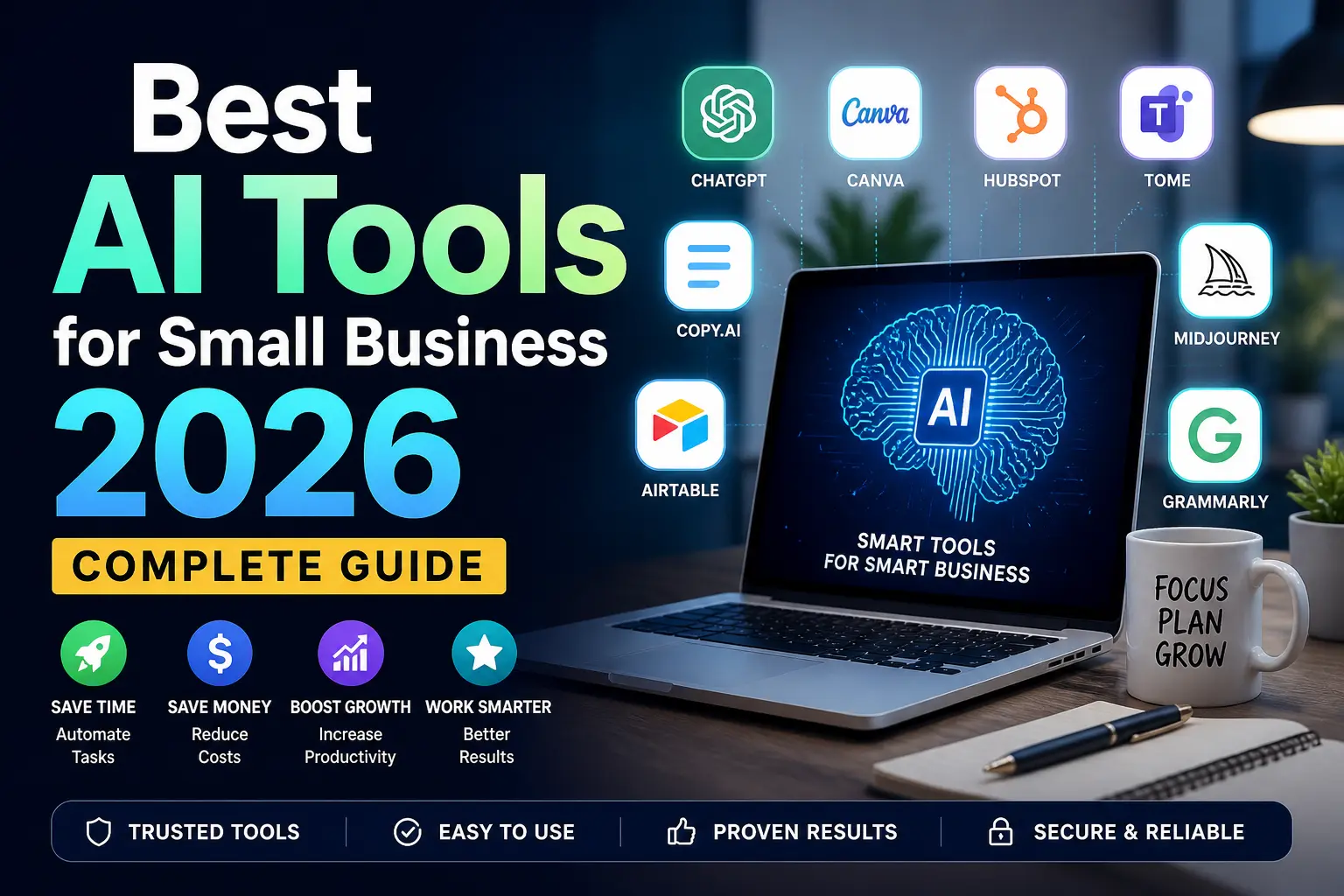
Best AI Tools for Small Business 2026: Complete Guide
Quick Answer
The best AI tools for small business in 2026 are ChatGPT for everyday writing and planning, Claude for complex analysis and long documents, Gemini for Google Workspace users, Jasper or Canva for marketing assets, and Zapier for automation. Start with one general assistant, then add specialized tools only when they save measurable time or revenue.
Best small business AI stack: quick pick
If you do not want to compare every tool, start with this stack and upgrade only when a workflow becomes important enough to justify the cost.
| Business need | Best first tool | Free option | Upgrade when… |
|---|---|---|---|
| Daily writing, planning, customer replies | ChatGPT or Claude | Free tiers | You hit usage limits or need longer documents. |
| Deep document analysis and strategy | Claude | Claude free tier | You work with long PDFs, contracts, briefs, or reports every week. |
| Google Workspace workflows | Gemini | Gemini free tier | Your team already lives in Gmail, Docs, Sheets, and Drive. |
| Marketing content and brand voice | Jasper or ChatGPT | ChatGPT free tier | You publish repeat campaigns, ads, emails, or landing pages. |
| Automation between apps | Zapier | Free/basic automation | You repeat the same manual transfer between tools every week. |
| Social graphics and simple visuals | Canva AI | Canva free tier | You need reusable branded templates and faster content production. |
Key Takeaways
- 82% of small business employers have invested in AI tools in 2026, up from less than 30% in 2024
- Small businesses use an average of 5 AI tools combined in “stacks” for different functions
- ChatGPT, Claude, and Gemini dominate as AI assistants, with 70% of businesses running hybrid AI approaches
- Typical ROI timeline is 3-4 months with annual spend of $1,500-2,500 for most small businesses
- Marketing automation and content creation are the #1 and #2 use cases, delivering immediate time savings
Why Small Businesses Can’t Ignore AI in 2026
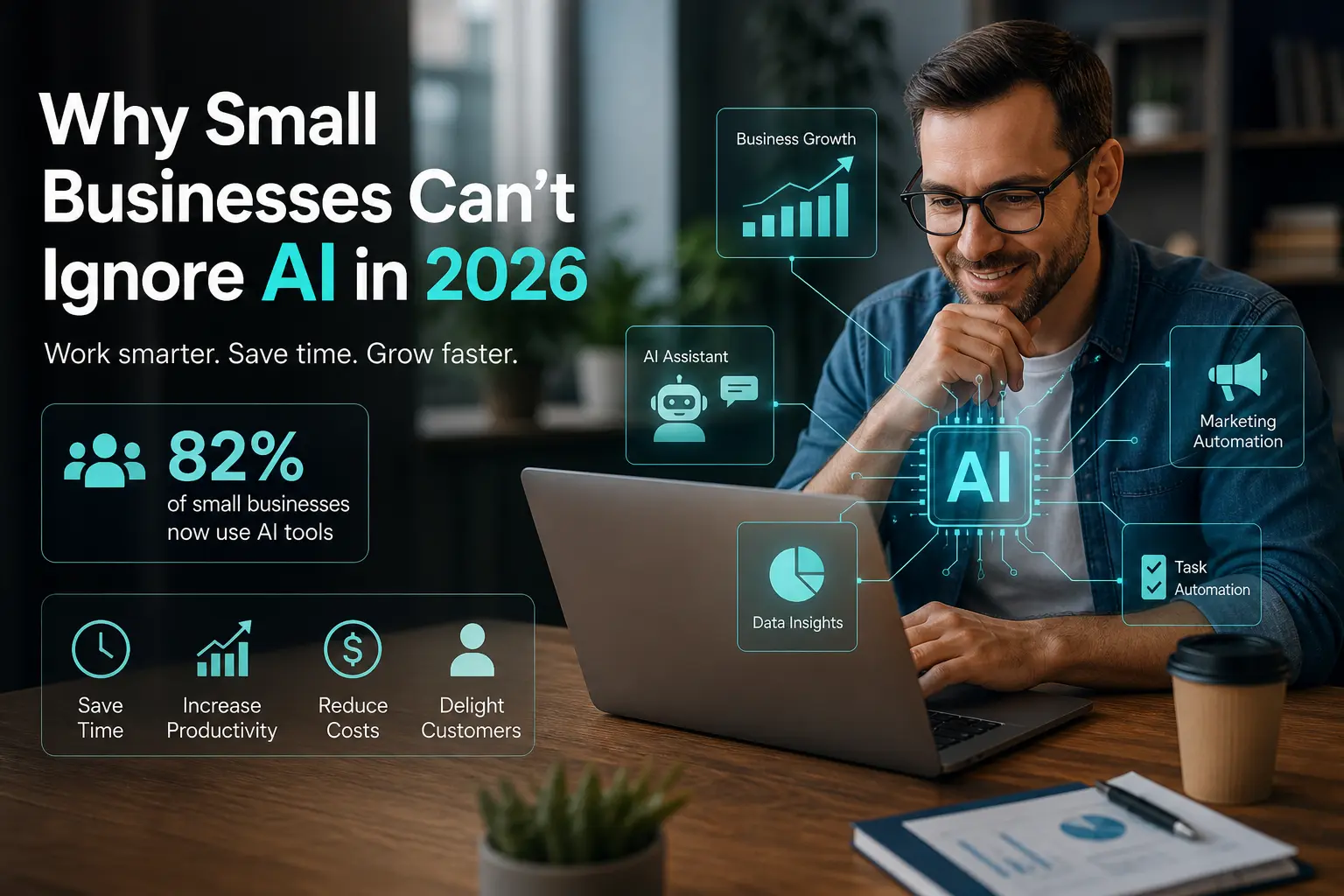
AI has moved from experimental to essential for small businesses. According to the SBE Council’s 2026 Small Business Tech Use Survey, 82% of small business employers have now invested in AI tools, and they’re rapidly embedding them across daily operations.
The shift happened fast. In 2024, fewer than 30% of small businesses used AI regularly. By early 2026, it became a competitive necessity. Small businesses that don’t adopt AI risk falling behind competitors who can produce content faster, respond to customers instantly, and make data-driven decisions in real time.
The Cost of Not Using AI
Running a small business means wearing multiple hats. You’re the CEO, marketer, customer support lead, and sometimes even the janitor. Without AI, you’re competing against businesses with seemingly unlimited resources. AI levels that playing field.
Three-person startups now have access to the same analytical power as Fortune 500 companies. Software providers have embedded AI directly into platforms businesses already use, meaning you can deploy sophisticated tools without writing a single line of code.
Real ROI: What the Numbers Show
Small businesses aren’t just experimenting — they’re seeing measurable results. Companies implementing AI-powered automation experience revenue increases of over 10% within 6-9 months, with an average return of $5.44 for every $1 invested.
Common time savings include 40-70% reduction in content creation time, 30-35% lower customer acquisition costs, and 5-15 hours saved weekly on routine administrative tasks. An HVAC company with a 5-person team reduced content creation from 15 hours per week to just 3 hours, while increasing lead volume by 42%.
Best AI Assistants: ChatGPT vs Claude vs Gemini
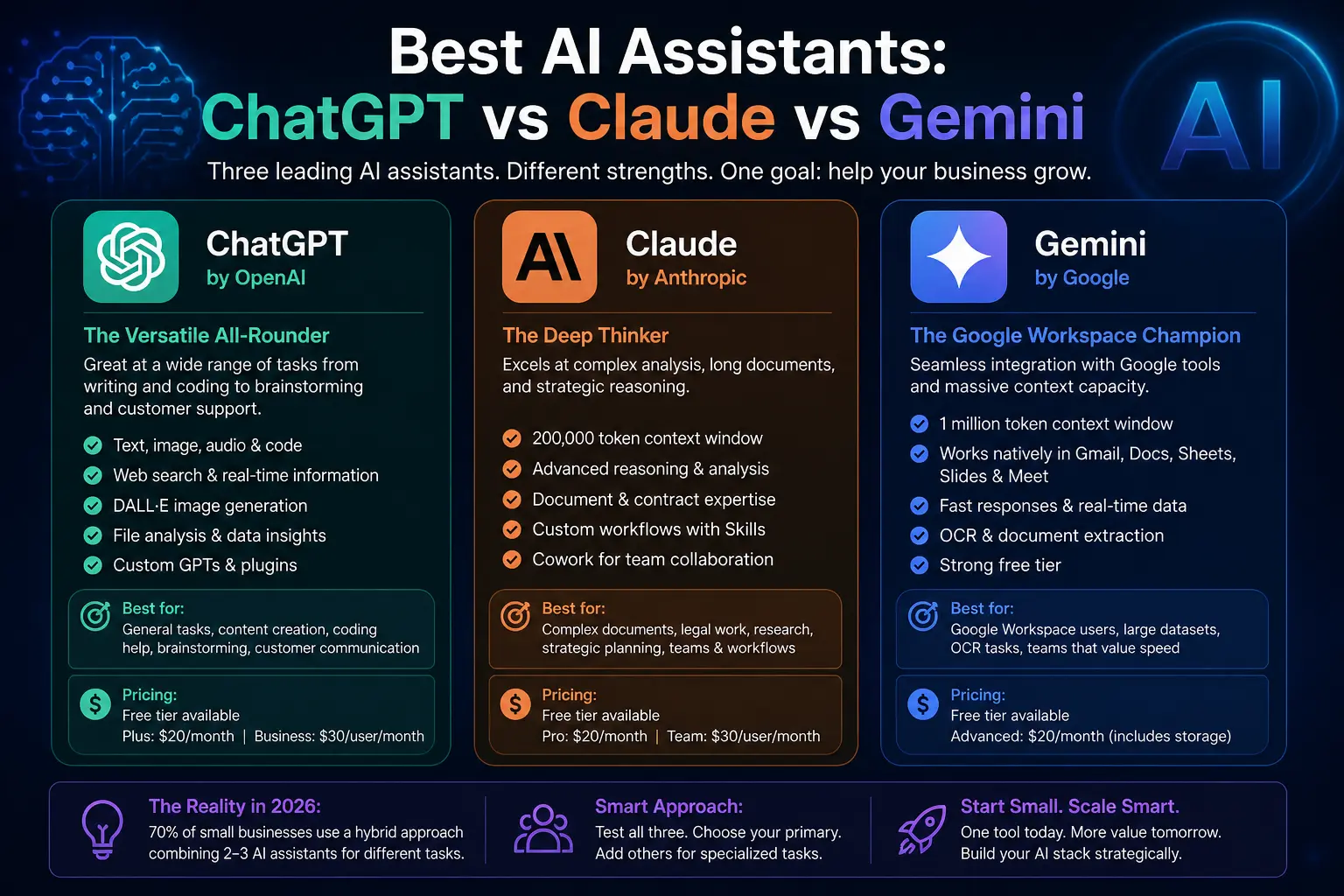
The three leading AI assistants in 2026 are ChatGPT (OpenAI), Claude (Anthropic), and Gemini (Google). While ChatGPT still commands roughly 65% of global AI traffic, many businesses are adopting hybrid approaches using multiple assistants.
ChatGPT: The Versatile All-Rounder
ChatGPT remains the most recognized AI assistant and the best starting point for most small businesses. Its strength isn’t being the best at any single task — it’s being genuinely capable across almost all of them.
The platform handles text, images, audio, and code in a single interface. Built-in tools include web search, code execution, DALL-E image generation, and file analysis. This breadth makes ChatGPT the most self-contained platform available.
Best for: General business tasks, coding help, quick content generation, brainstorming, customer communication templates
Pricing: Free tier available. ChatGPT Plus costs $20/month. Business tier is $30/user/month with higher limits and team features.
Claude: The Deep Thinker
Claude has emerged as the top choice for complex analysis and document-heavy work. Its standout feature is a 200,000-token context window — dramatically larger than competitors — which means it can process entire customer interview transcripts, contracts, or proposals in one session.
A 10-person Belgian consultancy switched their proposal workflow to Claude after discovering they could paste full RFPs, previous work samples, and client briefs all at once. Claude synthesizes everything into structured responses in minutes. Result: 40% faster proposals with fewer compliance gaps.
In 2026, Claude introduced new features like Cowork and Skills that allow businesses to create custom AI workflows. You can build a “mini replica” of your brain by feeding Claude your standard operating procedures, brand guidelines, and decision frameworks.
Best for: Complex document analysis, legal/contract work, detailed research, strategic planning, teams with established workflows to automate
Pricing: Free tier with limited access. Claude Pro costs $20/month. Team plan is $30/user/month with admin controls and higher limits.
Gemini: The Google Workspace Champion
Gemini is the clear winner for businesses already deep in Google Workspace. It integrates natively with Gmail, Docs, Sheets, Slides, and Meet with in-context awareness of your existing data that no other AI platform matches.
Gemini’s massive 1 million token context window is the largest available. A 15-person Dutch marketing agency dumps 50+ competitor websites, past campaigns, and market reports into Gemini every Monday. The AI spots trends they’d normally miss manually, resulting in 25% better click-through rates within two months.
The platform excels at speed — noticeably faster responses than ChatGPT and Claude. And the free tier is surprisingly capable, making it ideal for budget-conscious businesses testing AI before committing to paid plans.
Best for: Google Workspace users, processing large datasets, OCR and document extraction, teams prioritizing speed over deep reasoning
Pricing: Free tier with usage limits. Gemini Advanced costs $20/month and includes Google One storage benefits.
Which One Should You Choose?
The reality in 2026: most growing businesses don’t pick just one. According to recent benchmarks, 70% of small businesses now run hybrid AI stacks, combining tools for different tasks.
A practical starting approach: Create free accounts on all three platforms. Test your most annoying recurring task with each. After one week, choose the winner for a paid subscription. Within a month, consider adding a second tool for specialized tasks the first one doesn’t handle well.
Common hybrid patterns include using ChatGPT for quick content and coding, Claude for proposal and contract work, and Gemini for data analysis and spreadsheet tasks.
AI Marketing & Automation Tools
Marketing is the #1 use case for AI among small businesses. According to SBE Council’s survey, small business owners report improved customer reach, engagement, and revenue generation through AI-powered marketing tools.
Jasper: Content Creation Powerhouse
Jasper leads the pack for AI content generation. The platform cranks out blog posts, ad copy, social captions, and email campaigns with brand voice locked in. Small business owners particularly value its SEO templates and campaign workflow features.
The Content Pipelines feature automates the entire content lifecycle from planning to publication. You can generate multiple related assets simultaneously — a blog post with corresponding social media posts and email announcements — reducing coordination overhead.
Best for: Content-heavy businesses, agencies, teams needing consistent brand voice across channels
Pricing: Creator plan starts at $39/month. Pro plan ($59/month) supports up to 2 brand voices. Business plan offers unlimited brand voices with custom pricing.
HubSpot: All-in-One Marketing Hub
HubSpot combines CRM, marketing automation, email, SEO recommendations, and social media scheduling in one platform. This consolidation is a major advantage for teams wanting to reduce tool sprawl without sacrificing capability.
The AI features include predictive lead scoring (identifying which contacts are most likely to convert), email send time optimization, and content generation based on your brand voice and campaign goals. The free tier makes it accessible for smaller teams testing automation.
Best for: Businesses building their marketing function from scratch, teams wanting unified CRM and marketing data
Pricing: Free tier available with core features. Starter plan begins at $20/month. Professional and Enterprise plans scale with features and contact volume.
Klaviyo: E-commerce Email Expert
Klaviyo is purpose-built for e-commerce businesses selling directly to consumers. It integrates with Shopify, WooCommerce, and other platforms through 350+ pre-built integrations, automatically syncing purchase history and browsing behavior.
The AI-powered predictive analytics forecast customer lifetime value and churn risk, triggering retention campaigns before customers disengage. Product recommendation AI analyzes purchase patterns to suggest relevant items in emails, increasing average order value through personalized cross-sells.
Best for: E-commerce businesses, direct-to-consumer brands, product-based businesses needing personalized recommendations
Pricing: Free tier up to 250 contacts. Email plan starts at $20/month. SMS pricing varies by volume.
Canva: AI-Powered Visual Design
Canva allows you to create professional-quality images even if you’ve never designed anything before. The AI tools generate graphics, resize designs for different platforms, and suggest layouts based on your content.
A local retailer uses Canva to quickly create weekly promotional graphics for social media, reducing design time by up to 80% compared to hiring designers or learning complex software.
Best for: Social media graphics, ads, presentations, any business needing regular visual content
Pricing: Free tier with core features. Canva Pro costs $13/month. Teams plan starts at $30/month for up to 5 users.
Productivity & Workflow Tools
Zapier: The Integration Backbone
Zapier connects over 8,000 apps and serves as the nerve center of modern AI stacks. It links marketing, sales, operations, and service tools into one automated flywheel where data flows seamlessly and manual handoffs vanish.
The platform introduced Copilot in 2026 — a natural language builder for automation. Describe what you want to happen (“summarize new leads in Slack every morning”), and Copilot drafts a complete workflow, connects your accounts, maps the data, and tests each step automatically.
Zapier Agents take this further, acting as intelligent AI teammates that can handle multi-step actions across your tech stack autonomously. They work across apps even when you’re offline.
Best for: Businesses using multiple tools that need to communicate, teams wanting to automate repetitive data transfers
Pricing: Free tier for simple workflows. Starter plan begins at $20/month. Professional and Team plans scale with automation volume.
Grammarly: Professional Communication
Grammarly ensures everything you send is professional and clear. It goes beyond spell-check to refine tone, clarity, and engagement in emails, proposals, and customer responses.
A consultant uses Grammarly to polish client proposals and emails, increasing clarity and closing more deals. The AI understands context and suggests improvements based on your intended audience.
Best for: Client-facing businesses, consultants, anyone sending important written communication
Pricing: Free tier with basic checks. Premium costs $12/month. Business plan starts at $15/user/month.
Missive: Team Communication Hub
Missive brings all your customer and internal messages into one unified inbox — email, SMS, WhatsApp, Instagram, Messenger, and live chat. Teams can collaborate on replies behind the scenes without messy email forwards or CC chains.
The AI features are built directly into daily workflows, making them practical rather than gimmicky. AI can draft responses, summarize long threads, and suggest next actions based on conversation context.
Best for: Teams managing customer communication across multiple channels, businesses wanting to eliminate email chaos
Pricing: Free trial available. Starter plan begins at $14/user/month. Productive plan costs $18/user/month with AI features.
How to Build Your AI Stack for Small Business
The “Stack” Approach
Small businesses in 2026 aren’t relying on one tool. They’re building AI ecosystems that combine leading platforms to meet specific needs. The median small business now uses five AI tools.
Think of your AI stack in layers: foundation (AI assistant), communication (email and messaging), marketing (content and automation), operations (workflow and integration), and analytics (data and insights).
Recommended Starter Stacks by Business Type
Service Business (Consultants, Agencies): Claude or ChatGPT + HubSpot + Grammarly + Zapier. Total monthly cost: $80-100.
E-commerce: ChatGPT + Klaviyo + Canva + Shopify (with built-in AI features). Total monthly cost: $70-90.
Local Business (Restaurants, Retailers): Gemini (free) + Canva + HubSpot (free tier) + Meta Business Suite (free with AI features). Total monthly cost: $0-30.
Content Creator/Marketer: Claude + Jasper + Canva + Buffer or Hootsuite. Total monthly cost: $90-120.
Implementation Timeline
Don’t try to adopt everything at once. Follow this timeline:
Week 1: Create free accounts on ChatGPT, Claude, and Gemini. Test with one recurring annoying task. Choose your primary AI assistant.
Week 2-3: Add your paid AI assistant subscription ($20-30/month). Invite one trusted team member. Identify your biggest pain point — content creation, customer communication, or data analysis.
Month 2: Add one specialized tool for your biggest pain point. If it’s marketing, add Jasper or HubSpot. If it’s workflow, add Zapier. If it’s design, add Canva.
Month 3: Run a team workshop showing three real examples from your business. Start documenting what works and what doesn’t.
Month 4-6: Add 1-2 more tools as you identify gaps. Connect tools together using Zapier or native integrations. Most businesses hit their “sweet spot” stack at this point.
Common Mistakes to Avoid
Tool overload: Don’t subscribe to more than three paid tools in your first 90 days. Master basics before expanding.
Generic prompts: AI quality depends on prompt quality. Instead of “write a blog post,” try “write a 500-word blog post for plumbers in Seattle about winter pipe maintenance, casual tone, include local climate context.”
No integration: Disconnected tools create data silos. Use Zapier or native integrations to connect your stack.
Ignoring training: Set aside 2 hours weekly for the first month to learn your tools. Watch tutorials, read documentation, experiment with features.
No measurement: Track time saved, revenue impact, or customer satisfaction. If you can’t measure it, you can’t justify the subscription.
Frequently Asked Questions
What is the best AI tool for small businesses in 2026?
ChatGPT is the most versatile AI tool for small businesses in 2026, handling writing, coding, research, and customer support. However, Claude excels for complex document analysis, and Gemini is best for businesses using Google Workspace. Most successful small businesses use a combination of 3-5 AI tools in their stack.
How much do AI tools cost for small businesses?
Small businesses typically spend $1,500-2,500 annually on AI tools in 2026. Free tiers exist for most tools. Paid subscriptions range from $20-30 per month for AI assistants, with marketing automation tools costing $30-200 monthly depending on features and user count.
Can small businesses use AI tools without technical skills?
Yes. Modern AI tools in 2026 are designed for non-technical users. ChatGPT, Claude, and Gemini require no coding knowledge. Marketing automation platforms like HubSpot and Zapier offer visual workflow builders that anyone can use with minimal training.
What AI tools help with small business marketing?
The best AI marketing tools for small businesses include Jasper for content creation, HubSpot for automation and CRM, Canva for visual design, and Klaviyo for e-commerce email marketing. Zapier connects these tools together to create automated workflows.
How quickly can small businesses see ROI from AI tools?
Small businesses typically see ROI within 3-4 months of implementing AI tools. Common benefits include 40-70% reduction in content creation time, 30-35% lower customer acquisition costs, and 20-30% productivity gains. Businesses report saving 5-15 hours per week on routine tasks.
Should small businesses use free or paid AI tools?
Start with free tiers to test functionality and fit. Upgrade to paid plans once you’re consistently hitting usage limits or need advanced features. Most businesses find paid subscriptions worth it after 2-3 weeks of daily use. The time saved usually justifies the $20-30 monthly cost within the first month.
Final Thoughts
AI adoption among small businesses crossed the 80% threshold in 2026 for good reason. The tools work, they’re affordable, and they deliver measurable ROI in months, not years. The competitive gap between businesses using AI and those that aren’t is widening rapidly.
Start small. Pick one AI assistant this week. Add one specialized tool next month. Connect them together in month three. By the end of your first quarter using AI, you should be saving 5-10 hours weekly and seeing improvements in customer engagement or content output.
The businesses that win in 2026 aren’t just using AI — they’re using it strategically. Build your stack thoughtfully, measure what matters, and scale what works. Your competitors already are.
To turn a shortlist of tools into repeatable marketing, customer-service, and operations workflows, use our ChatGPT prompts for small business guide.
Part of the AI Tools series
This is part of our complete guide to AI tools in 2026:
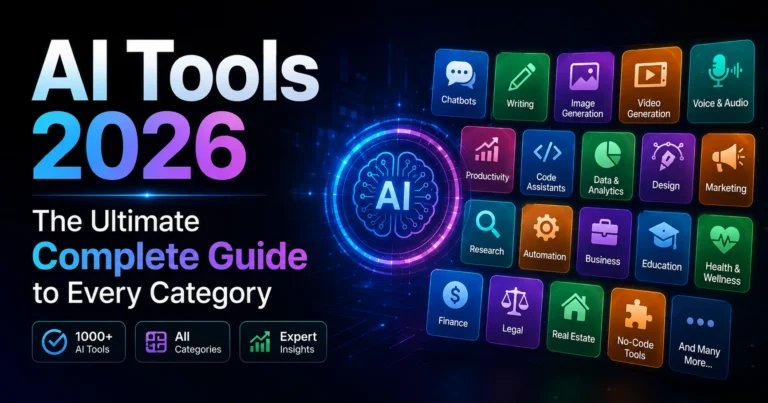
AI Tools 2026: The Ultimate Complete Guide to Every Category