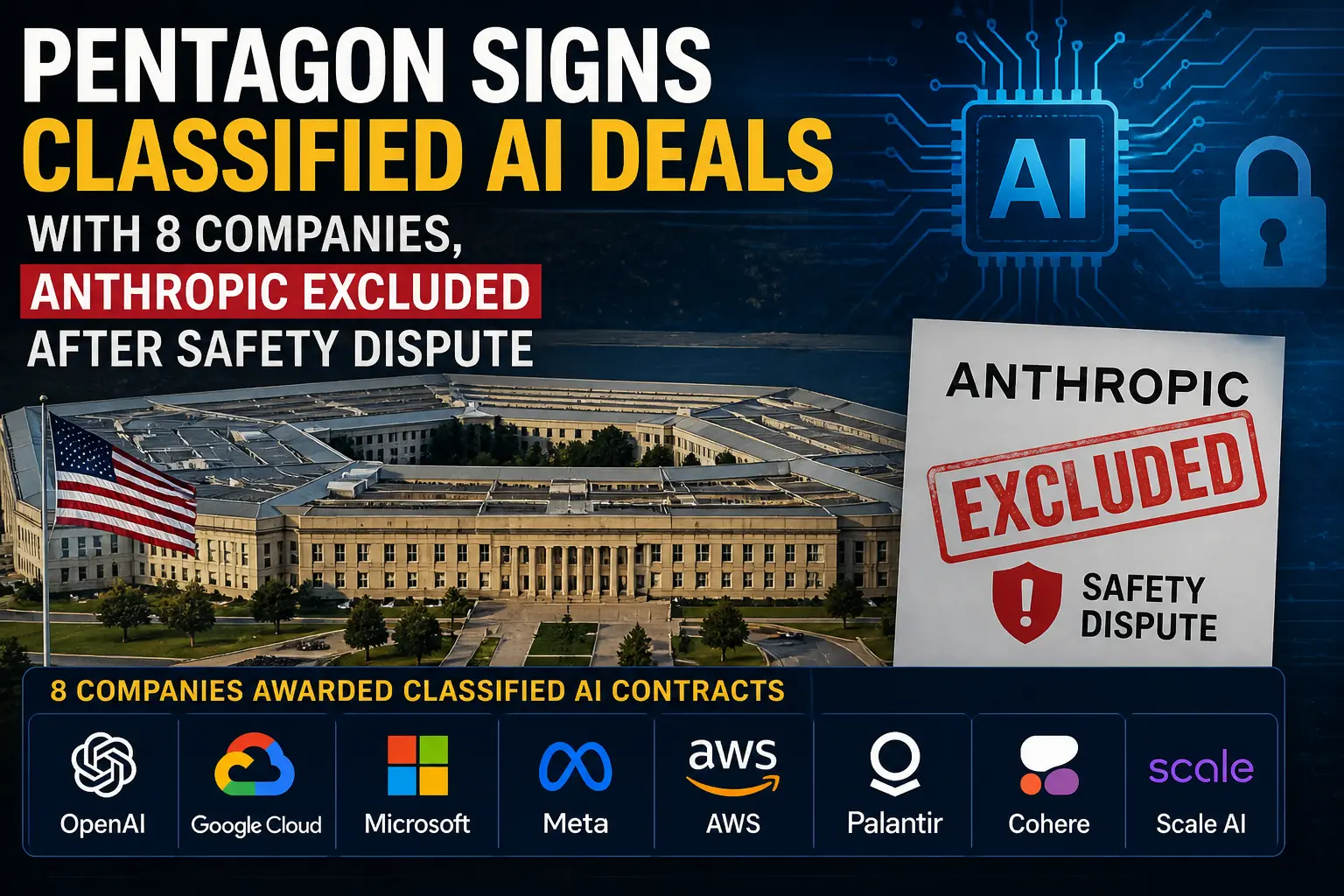
Pentagon signs classified AI deals with 8 companies Anthropic excluded after safety dispute
Pentagon AI Deals 2026: Quick Answer
Pentagon AI deals 2026: On May 1, 2026, the Pentagon signed classified AI deployment agreements with eight companies, OpenAI, Google, Microsoft, AWS, NVIDIA, SpaceX, Oracle, and startup Reflection AI. Notably absent: Anthropic, which is locked in a pair of federal lawsuits with the Defense Department after refusing to grant unrestricted access to its Claude AI for autonomous weapons and domestic surveillance.
Pentagon AI Deals 2026: Key Takeaways
- Eight AI companies, including OpenAI, Google, Microsoft, and NVIDIA, cleared to deploy on the Pentagon’s IL6 and IL7 classified networks as of May 1, 2026.
- Anthropic was excluded after refusing the Pentagon’s demand for “all lawful use” access to Claude, specifically over autonomous weapons and domestic mass surveillance.
- The Pentagon labeled Anthropic a “supply chain risk”, the first American company ever to receive that designation, historically reserved for foreign adversaries.
- A California federal judge issued an injunction blocking that designation in March 2026, ruling it violated Anthropic’s First Amendment rights; a federal appeals court declined to halt the litigation in April 2026.
- Startup Reflection AI, valued at $20 billion despite having released no public model, was included in the deals, a striking signal for open-weight AI in defense.
- Over 1.3 million DoD personnel already use GenAI.mil, the Pentagon’s unclassified AI platform launched in December 2025.
The US military just declared its AI vendor lineup for classified warfare and one of the most powerful AI labs in the world didn’t make the cut.
On May 1, 2026, the Department of War (the Trump administration’s rebrand of the Defense Department) announced it had finalized agreements with eight frontier AI companies to deploy their models on its most sensitive classified networks. The announcement was simultaneously a milestone for military AI integration and a pointed rebuke of Anthropic, whose months-long dispute with the Pentagon has become one of the most consequential AI policy fights in American history.
Here is what happened, who is in, who is out, and what the Pentagon AI deals 2026 signal for the AI industry’s relationship with the US government.
The eight companies that made the Pentagon’s classified AI list
The Department of War’s initial announcement on May 1 named seven companies. Hours later, the Pentagon CTO’s office posted on X that Oracle had been added, bringing the total to eight.
| Company | Role | Notable |
|---|---|---|
| OpenAI | Frontier LLM | Agreed to “all lawful use” provision |
| LLM + cloud infrastructure | Gemini 3.1 Pro already on GenAI.mil | |
| Microsoft | Cloud + Azure AI | Existing DoD cloud relationship |
| Amazon Web Services | Cloud infrastructure | Decade-long Pentagon cloud partner |
| NVIDIA | Compute + open models | Nemotron open-source models for agent tasks |
| SpaceX | Edge + satellite comms | Elon Musk’s close ties to Trump administration |
| Reflection AI | Open-weight frontier model | NVIDIA-backed startup; no public model released yet |
| Oracle | Cloud infrastructure | Added via X post later on May 1 |
All eight are now authorized to deploy on IL6 networks, handling data classified up to Secret and IL7 networks, which cover the most sensitive compartmented intelligence and operational systems. These are where the US military runs warfighting decision support, not back-office administration.
The DoD said the agreements will enable the military to “streamline data synthesis, elevate situational understanding, and augment warfighter decision-making in complex operational environments.” Contract values were not disclosed.
Why Anthropic was excluded and how the dispute escalated
Anthropic’s absence from the list is not an oversight. It is the direct result of a months-long standoff that has produced two federal lawsuits, a historic “supply chain risk” designation, a presidential order, and a preliminary injunction.
The core disagreement
The Pentagon wanted unfettered “all lawful use” access to Claude, meaning the military could deploy it for any purpose permitted by law, without contractual carve-outs. Anthropic drew two hard lines: it would not allow Claude to power fully autonomous weapons systems, and it would not allow it to be used for domestic mass surveillance of Americans.
The Pentagon’s position, as articulated by Pentagon CTO Emil Michael, was that existing federal law and DoD policy already prohibit those uses, and that no commercial vendor should be allowed to write usage restrictions into the chain of command. “We can’t have a company that has a different policy preference that is baked into the model… pollute the supply chain so our warfighters are getting ineffective weapons,” Michael told CNBC.
Anthropic’s position was that those existing protections are insufficient, and that Claude’s deployment at the frontier of military AI warranted explicit contractual guardrails.
How the Pentagon escalated
When talks broke down in early 2026, the Trump administration moved aggressively. Secretary of War Pete Hegseth formally designated Anthropic a “supply chain risk”, a designation federal law defines as applying to entities that may “sabotage, maliciously introduce unwanted function, or otherwise subvert” a national security system. It is a label historically reserved for foreign adversaries. Anthropic became the first American company to receive it.
President Trump then ordered all federal agencies to immediately cease using Anthropic’s technology, with a six-month phase-out period granted to DoD. Administration officials publicly called Dario Amodei’s leadership a “God-complex” and described Anthropic as a “radical left, woke company.”
On the day of the May 1 announcement, Pentagon CTO Emil Michael offered a thinly veiled reference to Anthropic on CNBC: “What we’ve learned since we started this effort at the Department of War is that it’s irresponsible to be reliant on any one partner, and we learned that that one partner didn’t really want to work with us in the way we wanted to work with them.”
The legal battle: where it stands as of May 2026
Anthropic responded to the supply chain risk designation with two simultaneous lawsuits, one filed in the US District Court for the Northern District of California, a second in the DC Circuit Court of Appeals, where a separate statute underpinning the Pentagon’s actions can only be challenged.
The California case produced an early win for Anthropic. On March 26, 2026, US District Judge Rita Lin issued a sweeping preliminary injunction blocking the supply chain risk designation. In a 43-page ruling, Lin wrote: “Nothing in the governing statute supports the Orwellian notion that an American company may be branded a potential adversary and saboteur of the U.S. for expressing disagreement with the government.” She ruled the designation violated Anthropic’s First Amendment and due process rights, calling the Pentagon’s actions “classic illegal First Amendment retaliation.”
The government appealed. On April 8, 2026, a federal appeals court in Washington denied Anthropic’s request for a stay meaning the legal fight continues but without the full halt on Pentagon actions that Anthropic had sought. The court acknowledged Anthropic “will likely suffer some degree of irreparable harm,” but ruled the company’s interests “seem primarily financial in nature.”
Anthropic’s CFO warned in a filing that the supply chain risk designation could cost the company “multiple billions of dollars” in 2026 revenue. The injunction blunted that partially, but the procurement exclusion on display May 1 is not something the courts can directly reverse the Pentagon has the legal right to choose different vendors.
What the Pentagon’s AI vendor sweep means for the industry
The May 1 agreements do more than resolve the immediate question of who the Pentagon is buying AI from. They establish a template for how the US government will manage AI procurement going forward and they send several clear signals to the market.
- Safety guardrails are negotiating liabilities, not selling points: Every company that made the list agreed to the Pentagon’s “all lawful use” provision. OpenAI, Google, and others accepted terms that Anthropic refused. For enterprise AI vendors negotiating government contracts, the message is unambiguous procurement officers will favor vendors who accept broad use authorization.
- Open-weight AI has arrived as a defense-grade option: NVIDIA’s Nemotron models and the inclusion of Reflection AI signal that the Pentagon is not betting exclusively on closed frontier models. NVIDIA CEO Jensen Huang has argued that open-source AI is superior for national security because its architecture is fully transparent and auditable. The Pentagon appears to agree.
- Vendor diversification is now explicit DoD policy: The Pentagon framed the eight-company approach explicitly around preventing “vendor lock.” The department said it will “continue to build an architecture that prevents AI vendor lock and ensures long-term flexibility for the Joint Force.” That is a structural shift from the concentrated Anthropic-Palantir relationship that preceded the dispute.
- GenAI.mil is scaling fast: Over 1.3 million DoD personnel have used the unclassified platform in five months, generating tens of millions of prompts and hundreds of thousands of AI agents. Pentagon officials said they expect additional models to come online within “the next few months” at the IL6 and IL7 classification levels.
Frequently Asked Questions
Which companies signed classified AI deals with the Pentagon?
Eight companies signed deals on May 1, 2026: OpenAI, Google, Microsoft, Amazon Web Services, NVIDIA, SpaceX, Reflection AI, and Oracle. Their AI models will run on IL6 and IL7 classified networks, the Pentagon’s two highest security tiers.
Why was Anthropic excluded from the Pentagon AI deals?
Anthropic refused to grant the Pentagon unrestricted “all lawful use” access to Claude, drawing a line at autonomous weapons and domestic mass surveillance. The Pentagon labeled Anthropic a “supply chain risk”, the first American company to receive that designation and excluded it from the classified network agreements.
What are IL6 and IL7 networks?
IL6 (Impact Level 6) handles data classified up to the Secret level. IL7 covers the most sensitive compartmented intelligence the Pentagon’s highest-tier operational systems. Together they are where the US military runs actual warfighting decision support, not administrative tasks.
Is Anthropic suing the Pentagon?
Yes. Anthropic filed two federal lawsuits challenging the supply chain risk designation. A California federal judge issued a preliminary injunction in March 2026 blocking the designation; a federal appeals court declined to issue a stay in April 2026. Both cases remain active.
What is GenAI.mil?
GenAI.mil is the Pentagon’s official AI platform, launched in December 2025. It handles non-classified tasks like research, document drafting, and data analysis. Over 1.3 million DoD personnel have used it, generating tens of millions of prompts in five months.
Final Thoughts
The Pentagon’s eight-company classified AI agreement is the most significant US military AI procurement event since the Cloud wars of the late 2010s. It formally ends Anthropic’s position as the Pentagon’s leading AI partner, replaces it with a deliberately diversified vendor stack, and establishes that government AI procurement will favor vendors who accept broad-use authorization over those who insist on ethical guardrails baked into their contracts.
Whether that trade-off is the right one for national security and whether Anthropic’s legal challenges ultimately reshape those terms is a question that will play out over the next 12 to 18 months in federal courts. For now, the practical answer is in the list of eight companies that signed on May 1.
For the broader picture on how AI agents are being deployed in enterprise and government settings, read our complete AI agents guide. For more on the US regulatory landscape shaping these decisions, see our breakdown of the 2026 National AI Policy Framework.
Sources
- US Department of War, Classified Networks AI Agreements official release, May 1, 2026
- Breaking Defense, Pentagon clears 8 tech firms to deploy AI on classified networks, May 1, 2026
- TechCrunch, Pentagon inks deals with Nvidia, Microsoft, and AWS, May 1, 2026
- CNN Business, Judge blocks Pentagon’s effort to label Anthropic a supply chain risk, March 26, 2026
- CNBC, Anthropic loses appeals court bid to temporarily block Pentagon blacklisting, April 8, 2026
- Axios, Anthropic sues Pentagon over “supply chain risk” label, March 9, 2026
- Federal News Network, DoD strikes deals with major tech firms, May 1, 2026