7 ChatGPT Alternatives 2026: Tested and Ranked
ChatGPT Alternatives 2026
TL;DR:
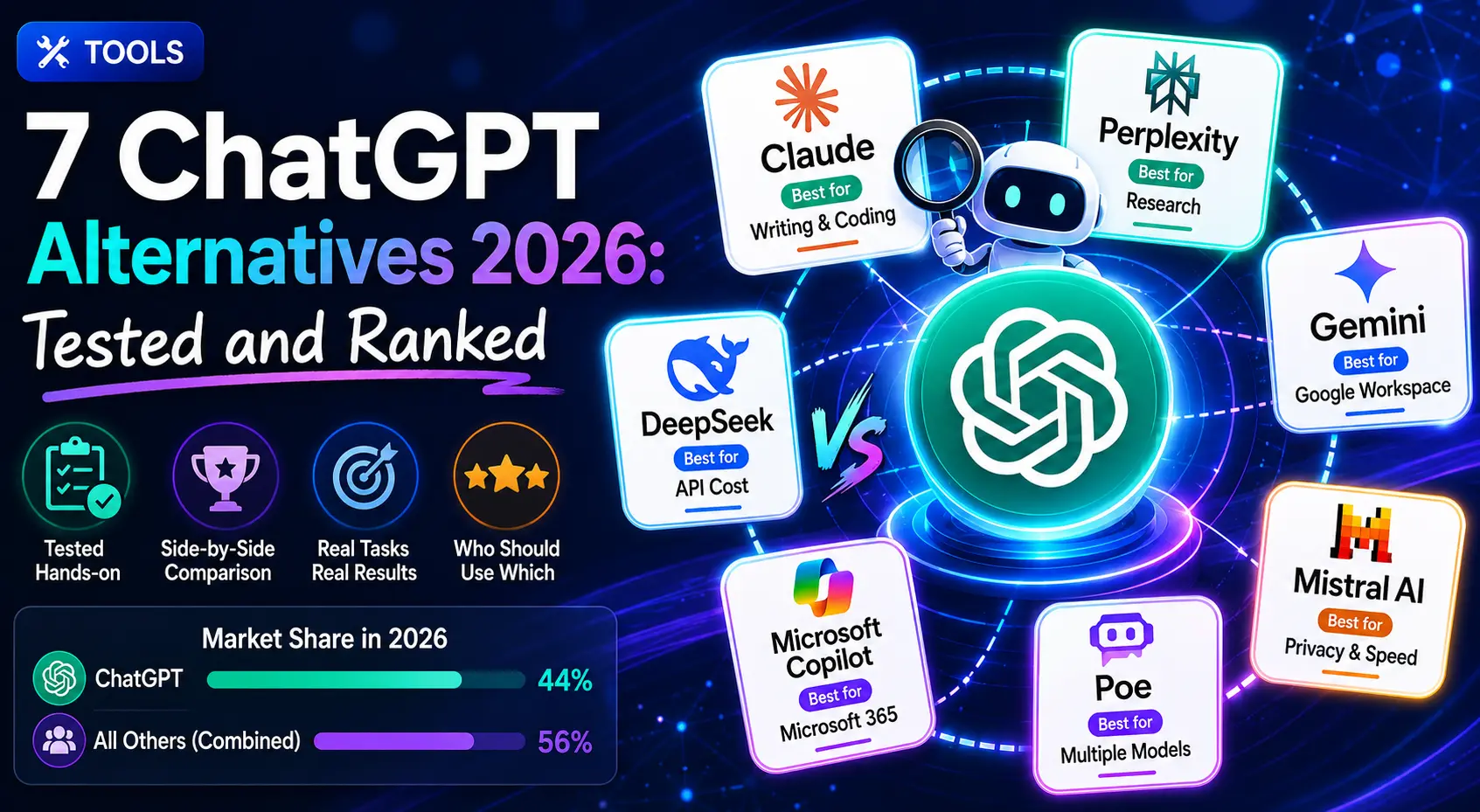
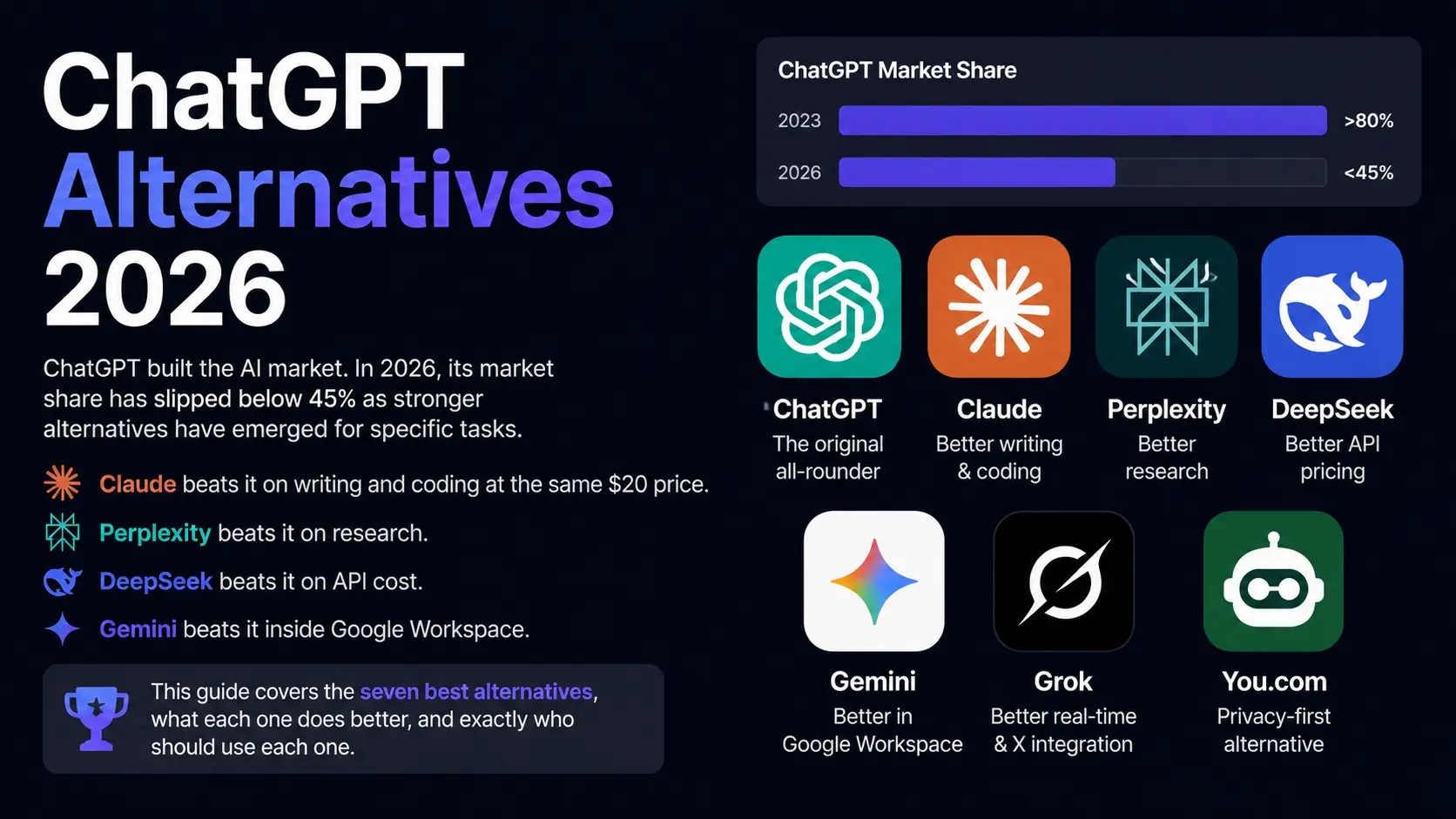
ChatGPT built the AI market. In 2026, its market share has slipped below 45% as stronger alternatives have emerged for specific tasks. Claude beats it on writing and coding at the same $20 price. Perplexity beats it on research. DeepSeek beats it on API cost. Gemini beats it inside Google Workspace. This guide covers the seven best alternatives, what each one does better, and exactly who should use each one.
Key takeaways
- ChatGPT’s share of the AI assistant market dropped from roughly 60% in early 2025 to under 45% by Q1 2026, driven by quality complaints after the GPT-5.x transition and aggressive upselling on the free tier.
- Claude Pro at $20 per month includes Claude Code, a full autonomous coding agent. ChatGPT charges $200 per month for comparable agentic capability in its Pro tier.
- Perplexity achieves 92% factual accuracy on real-time queries versus ChatGPT’s 87%, and cites every source inline so you never have to verify outputs manually.
- DeepSeek’s web chat is free with no usage cap. Its API V4 Flash costs $0.14 per million input tokens, the lowest price among capable frontier models available in 2026.
- Gemini AI Pro at $19.99 per month is the only AI assistant with native integration into Gmail, Docs, Drive, Sheets, and Calendar without plugins or tab-switching.
- Grok 4.20 introduced Rapid Learning, updating the model weekly based on real usage patterns, and is the only frontier model with native real-time access to the full X data stream.
ChatGPT launched the AI era. In 2026, the tools that learned from it are beating it at its own game.
OpenAI’s transition from GPT-4 to the GPT-5.x series changed how ChatGPT responds. Outputs got shorter. Refusals became more frequent on legitimate queries. The free tier grew more aggressive about upselling. OpenAI also launched display ads inside ChatGPT in February 2026. Meanwhile, Claude, Gemini, Perplexity, and DeepSeek each built a distinct advantage in one area where ChatGPT no longer leads.
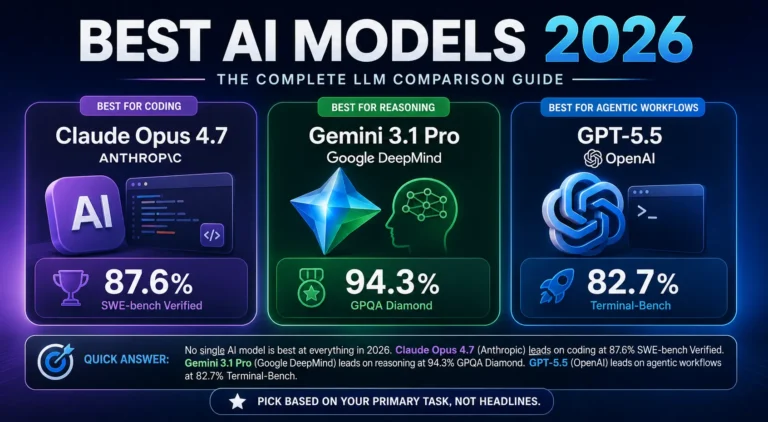
This article covers the seven strongest ChatGPT alternatives in 2026: what each one does better, what it costs, and exactly who should use it. For the full model-by-model benchmark landscape, see our Best AI Models 2026: The Complete LLM Comparison Guide.
Why ChatGPT is losing ground in 2026
ChatGPT remains the most widely recognized AI chatbot worldwide. But the market share numbers are moving in the wrong direction for OpenAI. Industry estimates put ChatGPT’s share of the AI assistant market at under 45% by Q1 2026, down from roughly 60% in early 2025.
The complaints clustering on developer forums and Reddit have been consistent since late 2025: responses are shorter and more generic than in the GPT-4 era; the same prompt produces noticeably different output depending on which GPT-5.x version is active; and the free tier surfaces upgrade prompts frequently enough to break workflow focus. The hashtag #QuitGPT gained real traction in early 2026, and search interest for alternatives has climbed steadily through Q2.
None of that makes ChatGPT a bad product. It remains excellent for image generation with DALL-E, voice interactions, one-off generation tasks, and anyone embedded in the OpenAI plugin ecosystem. The problem is that specialists have emerged, and they often cost the same or less.
All 7 alternatives at a glance
The table below covers each tool’s primary advantage over ChatGPT, free tier availability, and paid plan starting price as of May 2026.
| Tool | Beats ChatGPT at | Free tier | Paid from |
|---|---|---|---|
| Claude (Anthropic) | Writing quality, coding, long documents | Yes (Sonnet 4.6) | $20/mo (Pro) |
| Google Gemini | Google Workspace integration, multimodal | Yes (Gemini 3 Flash) | $7.99/mo (AI Plus) |
| Perplexity AI | Real-time research with cited sources | Yes (unlimited basic) | $20/mo (Pro) |
| Microsoft Copilot | Microsoft 365 integration, familiarity | Yes (with Microsoft account) | $30/user/mo (M365 Copilot) |
| Grok (xAI) | Real-time X/Twitter data, live intelligence | Yes (limited on X) | $30/mo (SuperGrok) |
| DeepSeek | API cost, open-source, self-hosting | Yes (free, no cap) | Free (API pay-per-token) |
| Meta AI | Free access, mobile-first, social app integration | Yes (fully free, no cap) | Free |
Pricing in USD as of May 2026. Source: official pricing pages for each provider.
1. Claude: best for writing and coding
Claude, built by Anthropic (San Francisco), is the strongest all-around ChatGPT alternative for text and code work. Writing output is consistently more natural and less generic than GPT-5.x responses. On complex multi-step reasoning, Claude Opus 4.6 matches or exceeds GPT-5.3 in independent benchmarks, and its 87.6% SWE-bench Verified score places it at the top of the coding category among frontier models.
The pricing story is where Claude pulls ahead most clearly. Claude Pro costs $20 per month and includes Claude Code, a full autonomous coding agent that handles multi-file edits, debugging, and project scaffolding directly in your terminal. ChatGPT charges $200 per month for comparable agentic capability in its Pro tier. For any developer or technical writer, that gap alone justifies evaluating the switch.
The context window is another practical advantage. Claude Opus 4.6 supports 1 million tokens, roughly the length of a full novel. For anyone analyzing long contracts, large codebases, or multi-chapter research documents without chunking, this beats ChatGPT Plus’s 128K context window in everyday use.
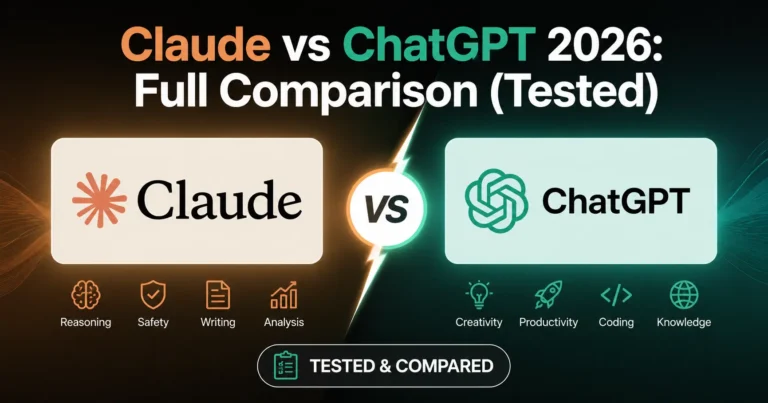
For a detailed head-to-head, see our full Claude vs ChatGPT 2026 comparison.
2. Google Gemini: best for Google Workspace users
Google Gemini (Google DeepMind, Mountain View) is the only AI assistant that works natively inside Gmail, Docs, Sheets, Drive, and Calendar without tab-switching or copy-pasting. If your workday runs on Google Workspace, Gemini’s integration advantage over ChatGPT is substantial and cannot be replicated with plugins alone.
Gemini AI Pro costs $19.99 per month, and gives access to Gemini 3.1 Pro with a 2 million token context window. That exceeds both ChatGPT Plus and Claude Pro on raw context capacity for large-scale document and data tasks. The Deep Research agent, now available on free and paid tiers, generates sourced research reports without manual follow-up prompting.
The entry tier at $7.99 per month (AI Plus) is also the cheapest paid AI subscription among the major tools, making Gemini the most accessible upgrade for light users who want more than the free tier offers.
3. Perplexity AI: best for research with citations
Perplexity AI is a fundamentally different product from ChatGPT. It is not a writing assistant. It is a research partner that reads the current web, synthesizes what it finds, and cites every source inline. For anyone who needs to verify facts, track recent developments, or do literature-style research quickly, Perplexity is the correct tool and ChatGPT is the wrong one.
Third-party testing puts Perplexity at 92% factual accuracy on real-time queries versus ChatGPT’s 87%. The gap matters most on time-sensitive topics where training data is stale. Ask Perplexity about a funding round announced last week and you get a sourced answer. Ask ChatGPT the same question and you often get a confident approximation or a refusal to speculate.
The free tier supports unlimited standard searches with no credit card required. Perplexity Pro at $20 per month (or $17 per month billed annually) adds over 300 Pro Searches per day using advanced models, file analysis, and image generation.
For a direct comparison, read our Perplexity vs ChatGPT 2026: Best AI Search Engine Tested.
4. Microsoft Copilot: best for Microsoft 365 users
Microsoft Copilot lives inside Word, Excel, Outlook, Teams, and PowerPoint. For anyone whose work is anchored in the Microsoft ecosystem, the integration advantage mirrors what Gemini offers Google users. The AI shows up inside the tools you already have open, rather than requiring a separate browser tab.
The free Copilot tier, available with any Microsoft account, provides a capable browser-based AI assistant with image generation powered by DALL-E. For enterprise teams, Microsoft 365 Copilot at $30 per user per month adds full workspace integration: meeting summaries in Teams, draft generation directly inside Word documents, and data analysis in Excel that reduces manual formula work significantly.
Voice chat quality is competitive with ChatGPT’s voice mode. The familiarity advantage is also real for organizations where employees have used Microsoft tools for years. Adopting Copilot requires no new mental model for the interface.
5. Grok by xAI: best for real-time data and live intelligence
Grok, built by Elon Musk’s xAI, has one capability no other frontier model offers: native real-time access to the full X (formerly Twitter) data stream. For anyone tracking fast-moving markets, political developments, tech launches, or cultural moments as they happen, Grok’s live X intelligence is a genuine and un-replicable advantage.
Grok 4.20 introduced Rapid Learning, updating the model weekly based on real usage patterns rather than waiting for quarterly model releases. This means Grok improves faster between major versions than static post-deployment models from OpenAI or Anthropic.
SuperGrok costs $30 per month, $10 more than ChatGPT Plus or Claude Pro. That premium is entirely justified by the X intelligence advantage for users who need it. If you do not need real-time X data, ChatGPT or Claude is better value at $20 per month. If live social and market intelligence is part of your workflow, nothing else provides it.
6. DeepSeek: best for budget developers and high-volume API work
DeepSeek is the cost story of 2026 AI. Its web chat is free with no usage cap. Its V4 Flash API model costs $0.14 per million input tokens and $0.28 per million output tokens, making it the cheapest capable model available for developers building AI-powered products. For comparison, GPT-5 API pricing runs significantly higher, and Claude Sonnet sits well above DeepSeek on a per-token basis.
DeepSeek is also open-source and can be self-hosted, which is what makes it directly relevant for US enterprises with strict data privacy or compliance requirements. When you self-host DeepSeek via providers like Groq, Together, or Fireworks AI, your data never leaves your infrastructure. No other frontier-quality model offers that combination of capability, cost, and data control.
The caveats are real and worth naming plainly. DeepSeek is a Chinese company and the default API routes through servers in China. For sensitive data, self-hosting is the recommended path. On the hardest reasoning tasks, response quality falls below Claude Opus 4.6 or GPT-5.3. For volume output at the lowest cost per token, it has no peer among accessible models in 2026.
7. Meta AI: best free option for everyday use
Meta AI, powered by Llama 4 from Meta Platforms (Menlo Park), is the most accessible AI assistant in 2026. It is completely free, has no usage cap, and is built directly into WhatsApp, Instagram, Facebook Messenger, and the Meta Ray-Ban glasses. If your AI use is casual, mobile-first, or primarily social, Meta AI removes any reason to pay for a subscription elsewhere.
Capability is solid for everyday tasks. Meta AI handles drafting messages, answering factual questions, summarizing content, and generating images well. For complex reasoning, long-document analysis, or serious coding work, it falls behind Claude and GPT-5.x. For free, frictionless AI in the apps you already have on your phone, nothing is more convenient in 2026.
Who should use which tool
Writers, editors, and content teams
Use Claude. Its output quality for long-form text is consistently above ChatGPT at the same $20 price point. The 1 million token context window means you can work with an entire manuscript without the model losing track of the opening section.
Developers and engineers
Use Claude for quality-first work. Use DeepSeek for high-volume API tasks where cost per token matters more than peak performance. Claude Code, included with the $20 Pro plan, handles agentic coding workflows that would cost $200 per month on ChatGPT Pro.
Researchers and analysts
Use Perplexity. Real-time sources, inline citations, and 92% factual accuracy on current-event queries make it the correct tool for any work where verification matters. Pair it with Claude for drafting once the research phase is complete.
Google Workspace teams
Use Gemini. The native integration with Gmail, Docs, and Sheets removes the copy-paste workflow that makes ChatGPT feel like a separate application rather than a part of how work gets done.
Microsoft 365 teams
Use Copilot. The same integration logic applies. AI that lives inside your existing tools removes the context-switching cost that adds friction to every AI-assisted task.
Frequently asked questions
What is the best free alternative to ChatGPT in 2026?
The best free alternatives to ChatGPT in 2026 are Claude free tier for writing and analysis, Perplexity free for research with citations, and Google Gemini free for general use and Google Workspace integration. Meta AI is also completely free and built into WhatsApp and Instagram with no usage cap.
Is Claude better than ChatGPT in 2026?
Claude is better than ChatGPT for writing quality, coding, and long-document analysis. Claude Pro at $20 per month includes Claude Code, a full autonomous coding agent, while ChatGPT requires a $200 per month Pro subscription for comparable agentic coding capability. ChatGPT remains ahead for image generation, voice mode, and breadth of third-party integrations.
Which ChatGPT alternative is best for research?
Perplexity AI is the best ChatGPT alternative for research in 2026. It cites every source inline, achieves 92% factual accuracy on real-time queries, and pulls from live web data rather than training data alone. The free tier supports unlimited basic searches. Perplexity Pro costs $20 per month and adds advanced model access and over 300 deep searches per day.
Why are people switching away from ChatGPT in 2026?
The main reasons users are switching from ChatGPT in 2026 include shorter and more generic responses since the GPT-5.x transition, frequent refusals on legitimate research queries, upsell prompts on the free tier, and the emergence of stronger specialized alternatives for coding, research, and long-document analysis.
What is the cheapest AI tool for developers in 2026?
DeepSeek is the cheapest capable AI tool for developers in 2026. Its web chat is free with no usage cap. The API V4 Flash model costs $0.14 per million input tokens and $0.28 per million output tokens, significantly cheaper than GPT-5 or Claude Sonnet for high-volume API work. DeepSeek is open-source and can be self-hosted for complete data control.
Part of the LLM Comparisons series
This article is one piece of our comprehensive guide on AI models in 2026. For benchmark scores, enterprise pricing, and model-by-model analysis across every major LLM, read the main guide:
Bottom line
There is no single best ChatGPT alternative in 2026 because no single tool leads across every category. Claude wins on writing and coding at the same $20 price point. Perplexity wins on research with citations. Gemini wins inside Google Workspace. Copilot wins inside Microsoft 365. DeepSeek wins on API cost for developers. Grok wins on real-time X data. Meta AI wins on free access with no friction.
The most effective AI users in 2026 are not committed to one tool. They pick the right specialist for each task. Running two or three free tiers alongside one paid plan costs less than using the wrong tool for work that matters.
For daily coverage of model releases, pricing changes, and what each update means for your workflow, subscribe to the BriefArticle daily brief.
Get the daily AI brief
Delivered at 7:30 AM EST, Monday to Friday. AI news in plain English. Free, no fluff, and unsubscribe anytime.