NotebookLM vs ChatGPT vs Perplexity: Best AI for Research
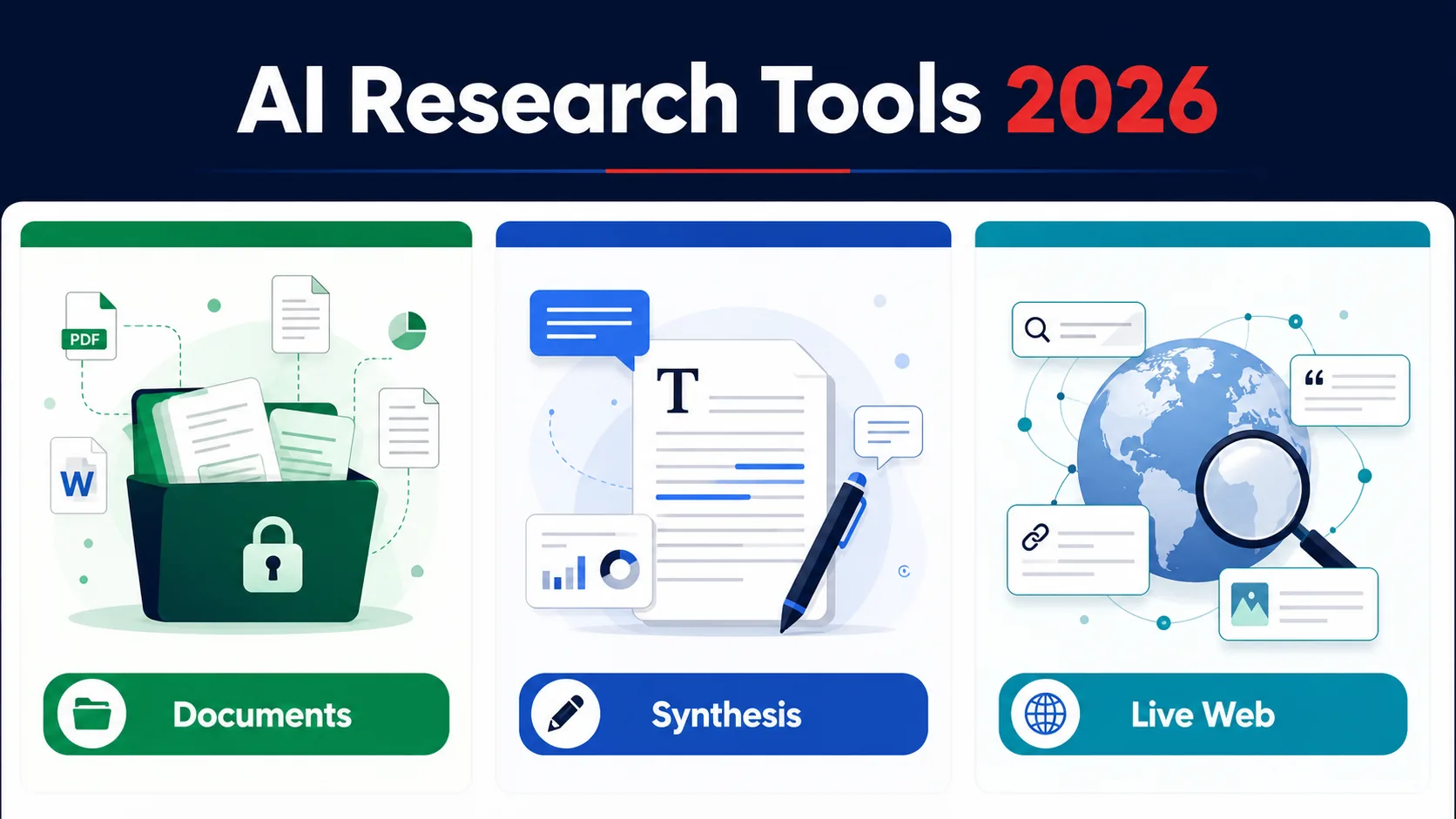
NotebookLM, ChatGPT, and Perplexity are designed for different stages of a research workflow rather than serving as direct alternatives. NotebookLM is best suited for analyzing uploaded documents, Perplexity functions as a cited web search tool for current sources, and ChatGPT excels at synthesizing gathered material into polished final writing.
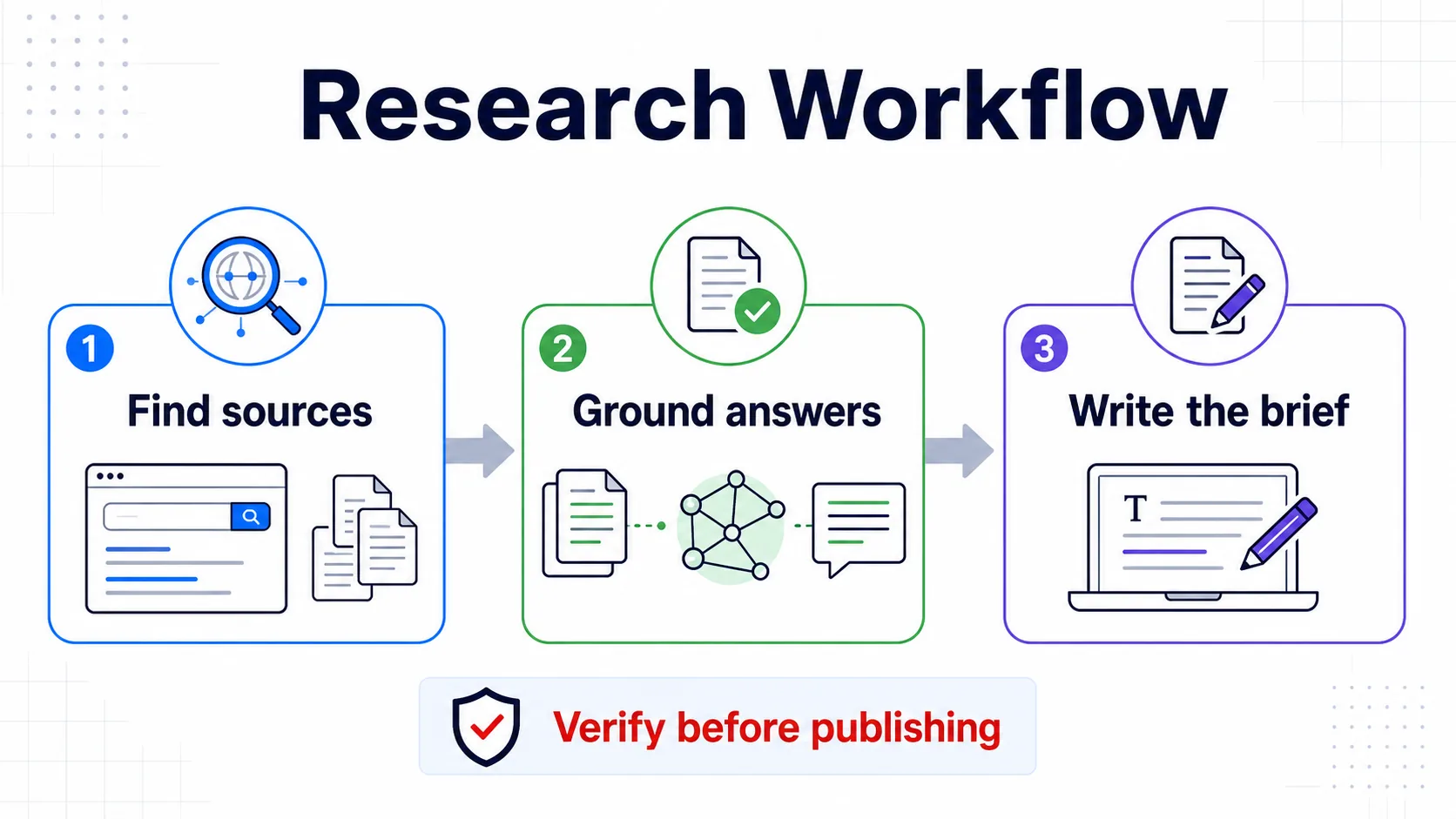
The recommended approach combines all three tools in sequence: Perplexity for discovering web sources, NotebookLM for grounding answers in trusted documents, and ChatGPT for producing reports, memos, or articles. Regardless of which tool is used, verifying important claims against original sources remains essential before publishing or making decisions.
Update: Google renamed NotebookLM to Gemini Notebook in 2026. See our Gemini Notebook rename guide for what changed and what stayed the same.
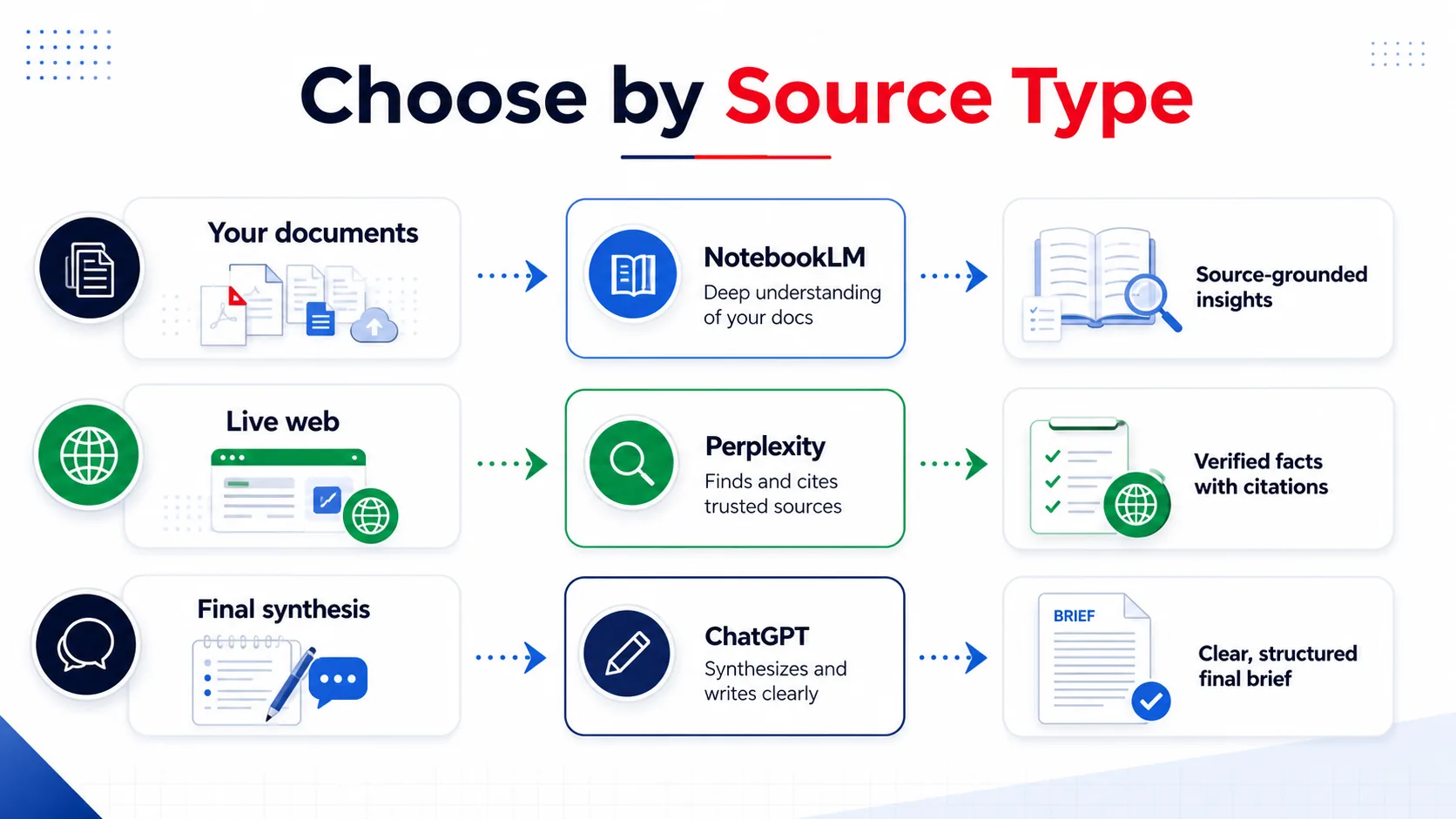
This NotebookLM vs ChatGPT vs Perplexity guide compares the three tools by source type, research workflow, citations, document grounding, and final writing quality.
NotebookLM, ChatGPT, and Perplexity can all help with research, but they are not built for the same job. NotebookLM is strongest when you want answers grounded in your own sources. Perplexity is strongest when you need fast web research with citations. ChatGPT is strongest when research needs to become a clear brief, report, article, email, or strategy.
If you only remember one thing: use NotebookLM for your documents, Perplexity for the open web, and ChatGPT for synthesis. That workflow is more reliable than trying to force one AI tool to do every research task.
Quick verdict: which AI research tool should you use?
Use NotebookLM when you already have PDFs, notes, reports, transcripts, slides, or Google Drive documents. Use Perplexity when you need fresh web sources and quick cited answers. Use ChatGPT when you need to compare ideas, reason through tradeoffs, and turn messy research into polished writing.
NotebookLM vs ChatGPT vs Perplexity: quick comparison
| Use case | Best choice | Why |
|---|---|---|
| Researching your own PDFs or notes | NotebookLM | It is designed to work from sources you add to a notebook. |
| Finding current web sources | Perplexity | It behaves like an AI search engine and returns cited answers quickly. |
| Writing a final report or article | ChatGPT | It is better at synthesis, outlining, rewriting, and turning research into a finished draft. |
| Studying lectures or class material | NotebookLM | It can stay close to your uploaded notes and documents. |
| Comparing tools, prices, and recent updates | Perplexity + ChatGPT | Perplexity finds sources; ChatGPT turns them into a decision. |
| Business research workflow | All three | Perplexity for discovery, NotebookLM for trusted documents, ChatGPT for the final memo. |
The short answer: there is no single winner
Most AI tool comparisons try to name one winner. For research, that is the wrong question. The better question is: where do your sources come from?
- If your sources are files you already trust, start with NotebookLM.
- If your sources are pages across the web, start with Perplexity.
- If your sources are messy and you need a final answer, use ChatGPT after collecting the evidence.
This is why NotebookLM, ChatGPT, and Perplexity should not be seen as simple replacements for each other. They sit at different points in the research workflow.
NotebookLM: best for source-grounded research
NotebookLM is the best choice when you want an AI assistant to work inside a controlled set of sources. Instead of asking the open web for an answer, you add the material you want it to use: PDFs, documents, notes, transcripts, slides, websites, or other supported source types.
That makes NotebookLM especially useful for students, researchers, analysts, legal teams, consultants, and anyone working with internal documents. If the answer needs to come from a specific report or source pack, NotebookLM is usually safer than asking a general chatbot from memory.
NotebookLM is best for
- Summarizing long PDFs and research papers.
- Finding answers inside your own documents.
- Studying lecture notes, class material, and transcripts.
- Building a source-grounded brief from a fixed set of files.
- Checking what a document actually says before writing about it.
NotebookLM is not ideal for
- Broad open-web research when you do not already have sources.
- Finding breaking news or very recent product changes.
- Writing highly polished final copy without another editing pass.
- Replacing a search engine for discovery work.
Best practical use: upload the sources you trust, ask NotebookLM to extract the main claims, then use those notes as the foundation for your final brief.
ChatGPT: best for synthesis and final writing
ChatGPT is the best all-around assistant in this comparison. It is not always the best first step for research, but it is often the best final step. Once you have sources, notes, quotes, or conflicting arguments, ChatGPT is strong at organizing them into a clear structure.
This is where ChatGPT becomes useful for writers, marketers, founders, analysts, and small business owners. You can give it research notes and ask for a decision memo, content brief, comparison table, executive summary, email, script, or article outline.
ChatGPT is best for
- Turning research into a readable article or report.
- Comparing arguments and building decision frameworks.
- Rewriting complex notes in plain English.
- Creating outlines, briefs, drafts, tables, and summaries.
- Combining research with your own instructions and brand voice.
ChatGPT is not ideal for
- Research tasks where every claim must be tied to a visible source.
- Blindly answering from memory on fast-changing topics.
- Replacing dedicated source management when documents are the main evidence.
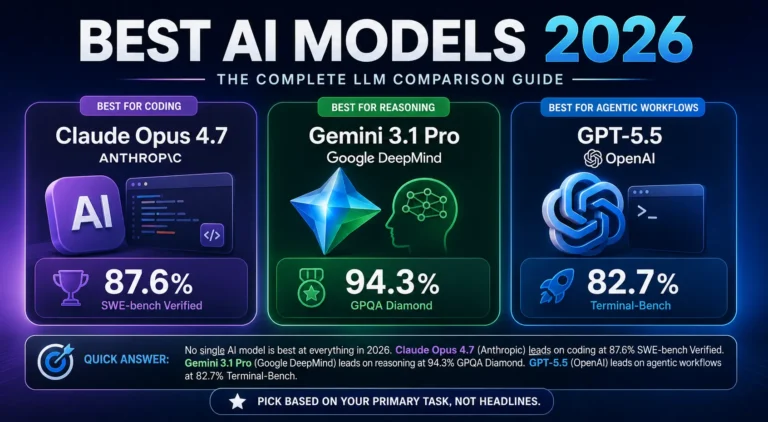
If you use ChatGPT for research, ask it to separate facts from interpretation. For important work, use it after you collect sources, not before. For broader model selection, read our Best AI Models 2026 comparison.
Perplexity: best for fast web research with citations
Perplexity is the best starting point when you need a quick map of the current web. It works like an answer engine: you ask a question, it searches, summarizes, and gives you sources to inspect. That makes it useful for current topics, product comparisons, market research, and source discovery.
Perplexity is not perfect, and you should still open important sources yourself. But compared with a normal chatbot, it pushes you toward cited answers faster. For research tasks that begin with “what changed recently?” or “what are the best sources on this?”, Perplexity is usually the fastest first step.
Perplexity is best for
- Finding current sources on the web.
- Comparing products, tools, prices, and recent announcements.
- Getting a cited overview before deeper research.
- Discovering sources you can later verify manually.
- Researching AI tools, software updates, market moves, and news.
Perplexity is not ideal for
- Working deeply inside your private document collection.
- Writing final drafts with a very specific voice.
- Long multi-step planning where the source search is only one part of the job.
For a deeper head-to-head search comparison, see our Perplexity vs ChatGPT 2026 test.
Best AI research workflow in 2026
The strongest workflow is not choosing one tool. It is using the right tool at the right stage.
- Start with Perplexity to discover current sources, official pages, news, and competing explanations.
- Move trusted documents into NotebookLM when you need answers grounded in a fixed source set.
- Use ChatGPT to synthesize the notes into a final article, memo, decision table, or presentation outline.
- Manually verify important claims before publishing, especially for pricing, laws, health, finance, or product availability.
This workflow is especially useful if you publish content, write reports, or make business decisions. Perplexity helps you find the landscape. NotebookLM helps you stay grounded. ChatGPT helps you produce the final deliverable.
Which is best for students?
For students, NotebookLM is usually the best first tool. It can help you study your own course material, lecture notes, PDFs, and assigned readings. That matters because school work often depends on specific sources, not random web answers.
ChatGPT is better after the study phase. Use it to explain concepts in simpler language, create practice questions, rewrite notes, or help structure an essay. Perplexity is useful when you need background reading or current sources, but you should avoid copying its answer directly into assignments.
Student workflow: NotebookLM for course sources, Perplexity for additional references, ChatGPT for explanation and writing practice.
Which is best for bloggers and content creators?
For bloggers, Perplexity is the best research starter and ChatGPT is the best writing partner. Perplexity helps you find sources and spot angles. ChatGPT helps you turn those sources into outlines, intros, tables, FAQs, and readable sections.
NotebookLM becomes useful when you have your own source pack: interview transcripts, product docs, PDF reports, YouTube transcripts, or notes from previous research. If you are building an authority site, this source-grounded workflow can make your content more original than simply rewriting search results.
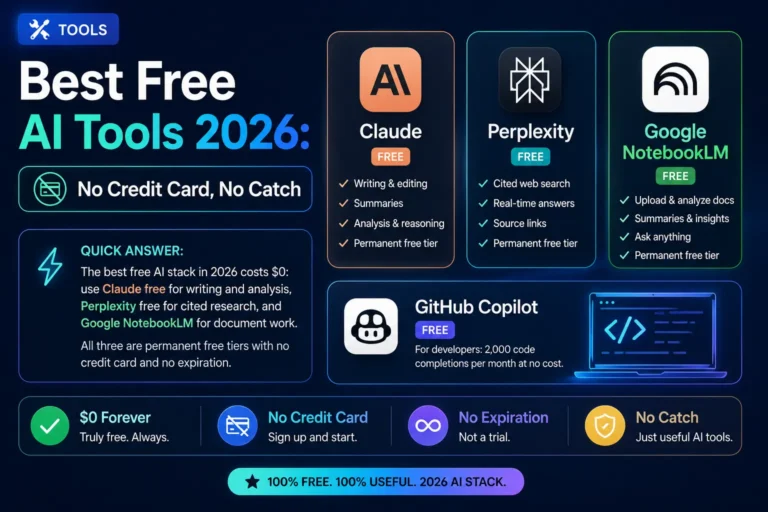
For broader tool selection, compare this guide with our AI Tools 2026 complete guide and our Best Free AI Tools 2026 list.
Which is best for business research?
For business research, the best answer is usually all three. Perplexity can scan the market. NotebookLM can analyze your internal documents or trusted reports. ChatGPT can turn everything into a memo, plan, sales brief, or executive summary.
| Business task | Best tool | Example |
|---|---|---|
| Competitor scan | Perplexity | Find current pages, pricing, announcements, and reviews. |
| Internal knowledge base | NotebookLM | Ask questions across reports, policies, notes, and source packs. |
| Executive summary | ChatGPT | Turn research notes into a clear decision memo. |
| Content plan | ChatGPT + Perplexity | Find current topics, then build article briefs and outlines. |
If your research is for a small business, you may also want our Best AI Tools for Small Business 2026 guide.
Accuracy and citations: which one should you trust?
Do not trust any AI tool blindly. Trust the sources. The main difference between these tools is how easy they make source checking.
- NotebookLM is easier to audit when all the relevant information is in your uploaded sources.
- Perplexity is easier to audit when the question depends on current web pages and citations.
- ChatGPT is strongest when you provide sources and ask it to reason from them, but weaker if you ask it to answer from memory on fast-changing topics.
For high-stakes research, use the tool to accelerate reading, not replace reading. Open the original source before publishing a claim.
Final recommendation
NotebookLM is the best AI research tool for your own documents. Perplexity is the best AI research tool for the live web. ChatGPT is the best AI research tool for turning information into useful writing.
If you are choosing only one tool, choose based on your source type:
- Choose NotebookLM if your research starts with PDFs, notes, or documents.
- Choose Perplexity if your research starts with Google-style web questions.
- Choose ChatGPT if your research ends in a report, plan, article, or final answer.
For most serious research workflows, the best setup is simple: Perplexity to find, NotebookLM to ground, ChatGPT to synthesize.
FAQ
Is NotebookLM better than ChatGPT for research?
NotebookLM is better than ChatGPT when the research must stay grounded in your own documents and sources. ChatGPT is better when you need to synthesize research into a final article, memo, report, or explanation.
Is Perplexity better than ChatGPT for web research?
Perplexity is usually better as a first step for web research because it is built around search and citations. ChatGPT is better after source collection, when you need deeper reasoning, rewriting, or final synthesis.
Which AI tool is best for students?
NotebookLM is the best first choice for students working with class notes, PDFs, lectures, and assigned readings. ChatGPT is useful for explanations, practice questions, and essay structure. Perplexity is useful for finding additional web sources.
Can NotebookLM replace Perplexity?
No. NotebookLM and Perplexity solve different problems. NotebookLM works best with sources you add. Perplexity works best when you need to discover and summarize sources from the web.
Can Perplexity replace ChatGPT?
Perplexity can replace ChatGPT for quick cited web answers, but not for every writing or reasoning task. ChatGPT is usually stronger for rewriting, planning, synthesis, and turning research into final deliverables.
What is the best AI research workflow?
The best workflow is to use Perplexity to discover current sources, NotebookLM to analyze trusted documents, and ChatGPT to synthesize everything into a final output.
Sources and fact-checking
- Google NotebookLM Help: NotebookLM Help Center
- Google Blog: NotebookLM Audio Overviews
- OpenAI Help Center: ChatGPT Help Center
- OpenAI Help Center: ChatGPT search
- Perplexity Docs: Perplexity documentation
- Perplexity Help Center: Perplexity Help Center
Fact checked and updated on June 3, 2026. AI product features, limits, pricing, and availability can change by plan and region. Always verify important claims in the original source before publishing or making business decisions.