Gemini vs GPT-5 2026: Which AI Model Actually Wins Big for Your Work
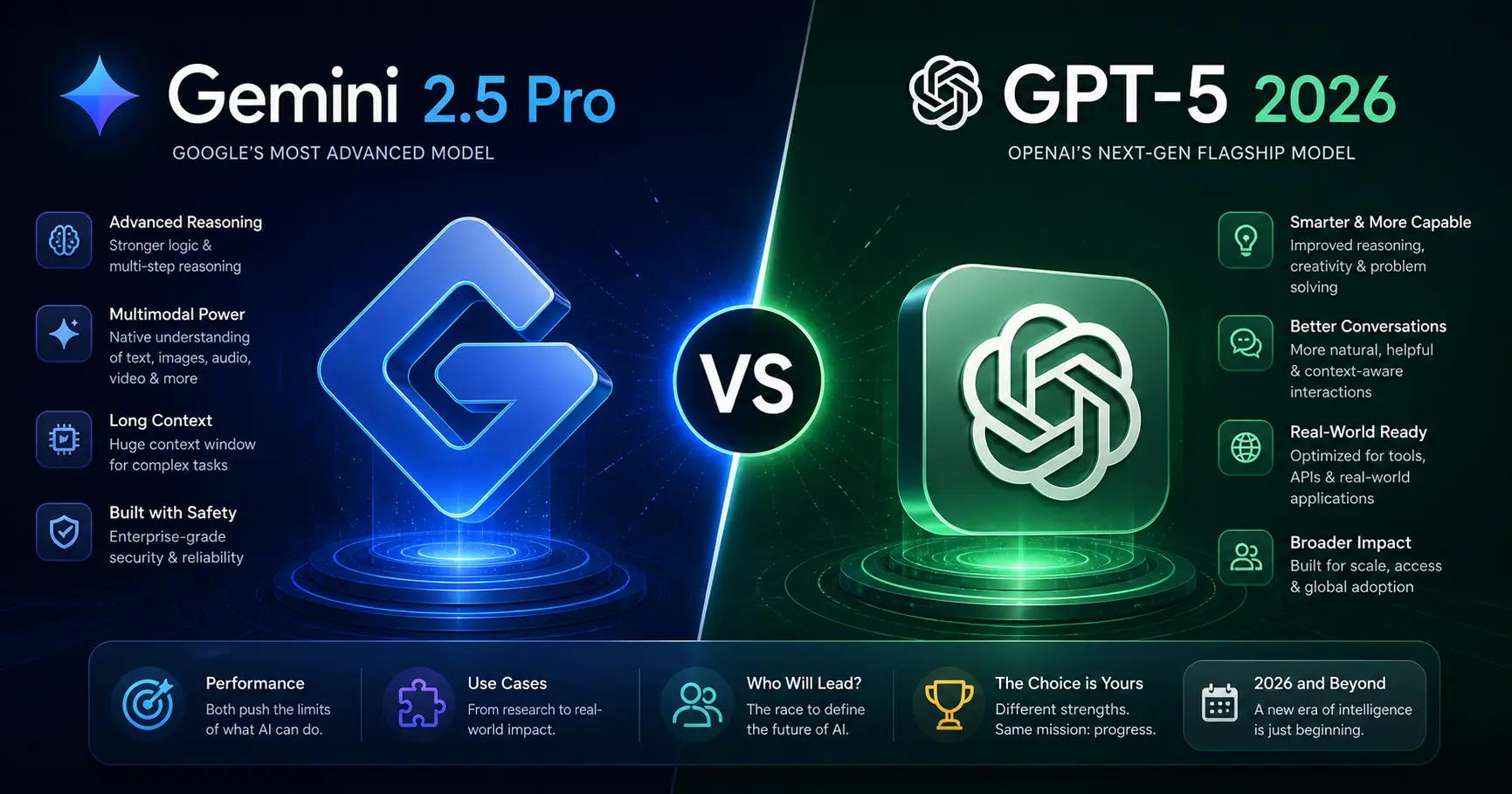
Gemini vs GPT-5 2026
GPT-5 wins for math, complex reasoning, and coding accuracy, scoring 94.6% on PhD-level AIME math problems versus Gemini’s 86.7%. Gemini 2.5 Pro wins for multimodal work, speed at 148 tokens per second versus GPT-5’s 102, and anyone operating inside the Google ecosystem. Both are priced at roughly $1.25 per million input tokens at base API tiers. Choose based on your workflow, not the brand.
Choose GPT-5 or Gemini by workflow
If you only need the practical answer, use this table before reading the full benchmark breakdown.
| Your workflow | Choose | Reason |
|---|---|---|
| Math-heavy reasoning, financial models, structured problem solving | GPT-5 | Stronger fit for precision tasks where one wrong step is costly. |
| Video, audio, images, long context, or Google Workspace workflows | Gemini 2.5 Pro | Better native multimodal support and deeper Google ecosystem integration. |
| Complex coding and agentic development workflows | GPT-5 | Better fit for multi-step coding, terminal work, and tool-based workflows. |
| High-volume API usage where speed and cost matter | Gemini 2.5 Pro | Faster output and more attractive economics at scale. |
| Small team choosing one everyday assistant | Depends on stack | Use GPT-5 if you live in Microsoft/GitHub; use Gemini if you live in Google Workspace. |
Key takeaways
- GPT-5 scores 94.6% on AIME 2025 math problems; Gemini 2.5 Pro scores 86.7%, according to Artificial Analysis benchmarks from March 2026.
- Gemini 2.5 Pro delivers responses at roughly 148 tokens per second; GPT-5 runs at about 102 tokens per second, making Gemini significantly faster in latency-sensitive applications.
- Gemini 2.5 Pro supports native video input, processing up to three hours of video in a single prompt. GPT-5 does not yet support direct video input.
- Both models are priced identically at base API tiers ($1.25 per million input, $10 per million output). At higher volume, Gemini 2.5 Pro is roughly 3x cheaper than GPT-5.5.
- GPT-5 earns a 74.9% SWE-bench Verified coding score; Gemini 2.5 Pro trails on that benchmark but leads on real-world, multimodal coding tasks involving video input or Google Cloud integrations.
- For Google Workspace users (Gmail, Docs, Drive), Gemini is the default choice. For Azure and GitHub Copilot workflows, GPT-5 integrates more naturally.
OpenAI and Google are now separated by a single benchmark point on the overall AI leaderboard — 84 to 83 — and the gap is closing every quarter.
But benchmark proximity disguises a real strategic divergence. GPT-5 is being built as a reasoning-first agent OS. Gemini 2.5 Pro is being built as a natively multimodal platform priced to capture volume. These are different bets, and they produce different winners depending on what you are actually trying to do.
GPT-5 wins for math, deep reasoning, and coding precision. Gemini 2.5 Pro wins for speed, multimodal tasks involving video and audio, and teams already using Google Workspace. This article tells you exactly when each model earns its price, with benchmark data and pricing reviewed in June 2026.
Quick verdict: Gemini 2.5 Pro vs GPT-5 at a glance
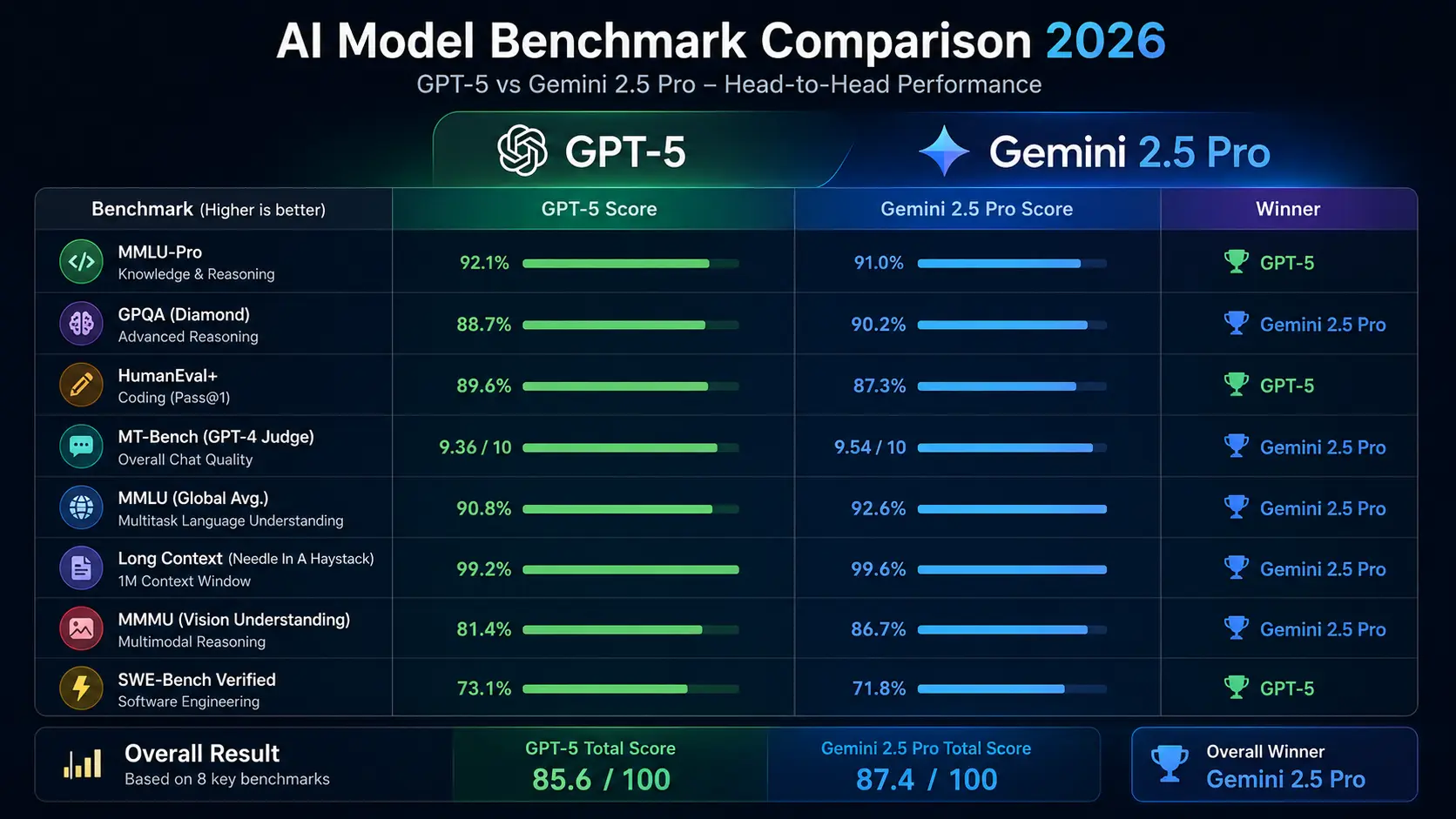
The table below covers every major decision category. Data is sourced from Artificial Analysis, BenchLM, and direct pricing pages as of May 2026.
| Category | GPT-5 | Gemini 2.5 Pro | Winner |
|---|---|---|---|
| Math reasoning (AIME 2025) | 94.6% | 86.7% | GPT-5 |
| Coding (SWE-bench Verified) | 74.9% | Competitive, lower | GPT-5 |
| Output speed | ~102 tokens/sec | ~148 tokens/sec | Gemini 2.5 Pro |
| Context window | 272K (1M in Codex) | 1M (2M coming) | Gemini 2.5 Pro |
| Video input | No | Yes (up to 3 hours) | Gemini 2.5 Pro |
| Writing quality | More human, adaptive | Crisp, factual | GPT-5 |
| Base API pricing (input/output) | $1.25/$10 per M tokens | $1.25/$10 per M tokens | Tie at base tier |
| Ecosystem | Azure, GitHub, Microsoft | Google Workspace, GCP | Depends on your stack |
Updated June 2026. All prices in USD. Benchmark references come from Artificial Analysis, BenchLM, and SWE-bench data published from March-May 2026.
Reasoning and math: where the gap between GPT-5 and Gemini is real
GPT-5 holds a meaningful edge on structured reasoning and competition mathematics. Its 94.6% score on AIME 2025 problems, which are PhD-level competition math, compares to Gemini 2.5 Pro’s 86.7%. That eight-point gap represents the difference between solving roughly 14 out of 15 problems versus 13.
On broader reasoning benchmarks, GPT-5.4 scores 92.8% on GPQA Diamond, while Gemini 2.5 Pro scores 94.3%, according to BenchLM data from March 2026. This is one of the few categories where Gemini edges ahead, suggesting strong scientific reasoning even if competition math is not its focus.
For US enterprises running financial modeling, pricing engine audits, or quantitative research workflows, GPT-5’s math lead translates directly to fewer production errors. In one documented test involving a derivatives pricing model, GPT-5 caught a boundary condition error in a Black-Scholes implementation that Gemini 2.5 Pro missed entirely while producing code that passed unit tests but failed on edge cases.
Coding: GPT-5 leads on precision, Gemini leads on multimodal and cost
GPT-5 earns a 74.9% SWE-bench Verified score and 75.1% on Terminal-Bench, which tests live terminal operations including DevOps, CI/CD debugging, and infrastructure-as-code tasks. These are the highest scores among broadly available models as of May 2026, according to the SWE-bench leaderboard and morphllm.com.
Gemini 2.5 Pro is a genuine competitor for coding, but its advantage sits in a different lane. Its tight integration with Google Cloud and developer tooling makes it the stronger choice for data analysis, API integration across Google services, and debugging in Python-centric environments. It also has a structural edge for any workflow that involves processing video tutorials, screen recordings, or visual debugging inputs alongside code.
Which coding model you should use
For DevOps-heavy workflows, complex bug detection in large codebases, and agentic coding pipelines using tools like GitHub Copilot: GPT-5 is the default. For cost-conscious development teams running pair programming at scale, or for any workflow mixing code with video, audio, or visual inputs: Gemini 2.5 Pro is increasingly hard to ignore, especially as Gemini 3.1 Pro now matches GPT-5.4 on SWE-bench Verified at roughly half the cost.
Multimodal capability: Gemini 2.5 Pro’s clearest and most defensible win
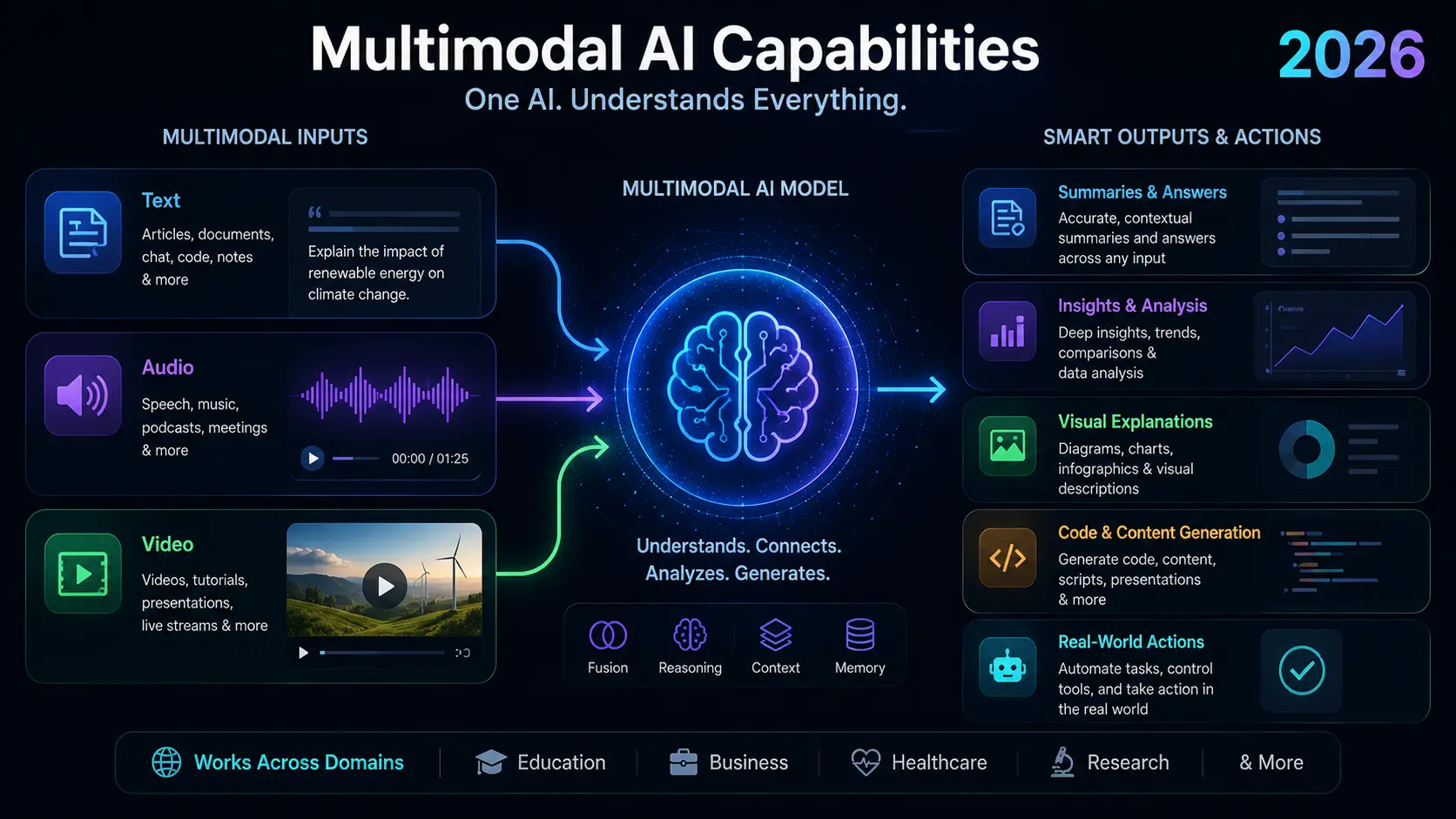
This is the category where the comparison is not close. Gemini 2.5 Pro accepts text, images, audio, video, code, and PDFs in a single request. GPT-5 accepts text, images, and files, with audio and video on the roadmap.
The practical difference matters for specific workflows. Gemini can ingest a raw 30-minute user testing session as an MP4, identify UX friction points, timestamp them, and suggest A/B test variations without any preprocessing. GPT-5 would require a Whisper transcription step, frame extraction, and prompt chaining to attempt the same task.
Gemini’s context window compounds this advantage. With a 1 million token window (and 2 million coming), it can ingest entire long documents, lengthy codebases, or hour-long video analysis sessions in one pass, preserving cross-references that RAG pipelines might miss. For research teams, compliance auditors, and video-first marketing teams, this single-prompt capacity is often the deciding factor.
Google also deepened this lead in early 2026 with Gemini Embedding 2, the first embedding model that maps text, images, video, audio, and PDFs into a single shared vector space. For retrieval pipelines across mixed-media content, no other provider currently matches this capability.
Pricing in 2026: identical at base, diverging at scale
| Plan | GPT-5 (OpenAI) | Gemini 2.5 Pro (Google) |
|---|---|---|
| Free tier | GPT-5 access with limited prompts | Gemini base model (less capable) |
| Consumer subscription (~$20/mo) | ChatGPT Plus: higher limits, model picker, GPT-5 and GPT-5 Thinking access | Google One AI Premium ($19.99/mo): Gemini 2.5 Pro + 2 TB cloud storage |
| API base tier (per M tokens) | $1.25 input / $10.00 output | $1.25 input / $10.00 output |
| API higher volume tier | $2.50 input / $15.00 output (GPT-5.4) | $2.00 input / $12.00 output |
| Batch API (12-24hr turnaround) | ~$1.50 input / $6.00 output per M tokens | ~$0.75 input / $3.50 output per M tokens |
Prices in USD as of May 2026. Enterprise pricing is negotiated separately at both providers. Annual volume commitments above $100K qualify for 20–40% discounts at both OpenAI and Google.
At base API pricing, you are essentially choosing based on capability, not cost. The separation comes at scale. For batch workloads tolerating a 12 to 24 hour turnaround, Gemini 2.5 Pro is roughly half the cost of GPT-5. At the consumer level, GPT-5 has the edge because it gives free users access to its flagship model, while Google’s free tier runs on a less capable Gemini version.
Who should use GPT-5 vs Gemini 2.5 Pro
Developers and engineers
Choose GPT-5 if your work is primarily terminal-heavy DevOps, large codebase refactoring, or complex bug detection where reasoning depth matters more than speed. Choose Gemini 2.5 Pro if you are building on Google Cloud, working in data analysis-heavy Python environments, or processing visual and video input alongside code. Both are strong coding tools; the decision comes down to ecosystem and task type.
Content creators, marketers, and writers
GPT-5 produces more natural, tonally adaptive writing. It shifts from formal to conversational registers more fluidly, making it the stronger choice for long-form content, email, and social copy. Gemini 2.5 Pro delivers crisp, factual output, which works better for summarization, structured reports, and research-driven content. If you work primarily inside Google Workspace, Gemini’s native Docs and Gmail integration reduces friction significantly.
Researchers and data-heavy teams
Gemini 2.5 Pro is the clear choice. Its 1M token context window, native video and audio input, and web search powered by Google’s search infrastructure give it a structural advantage for research workflows. GPT-5’s superior math reasoning makes it the better pick for quantitative research, financial analysis, or any task requiring precise numerical output. Use both: route multimodal and retrieval tasks to Gemini, and mathematical reasoning to GPT-5.
Business decision-makers evaluating at scale
Anthropic holds a current FedRAMP authorization advantage for US government-adjacent workloads, but between GPT-5 and Gemini, Google’s existing FedRAMP presence via GCP gives it an edge for regulated enterprises. OpenAI’s FedRAMP authorization was still in progress as of early 2026. Both providers offer zero-data-retention API tiers. For enterprises already on Azure: GPT-5. For enterprises already on GCP: Gemini. Switching ecosystems for a marginal benchmark difference is rarely worth the migration cost.
Frequently asked questions
Which is better, GPT-5 or Gemini 2.5 Pro?
It depends on your use case. GPT-5 is better for math-heavy reasoning, complex coding tasks, and writing with a natural human tone. Gemini 2.5 Pro is better for multimodal workflows involving video or audio, faster response times, and users embedded in Google Workspace. Neither model wins every category.
Is GPT-5 better at coding than Gemini 2.5 Pro?
GPT-5 scores 74.9% on SWE-bench Verified and 75.1% on Terminal-Bench, outperforming Gemini 2.5 Pro on both benchmarks as of May 2026. For complex bug detection, large codebase navigation, and DevOps workflows, GPT-5 is the stronger choice. Gemini 2.5 Pro is competitive for real-world coding tasks and costs less at scale.
Does Gemini 2.5 Pro support video input?
Yes. Gemini 2.5 Pro accepts native video input and can process up to three hours of video in a single prompt without transcription or preprocessing. GPT-5 does not currently support direct video input at the consumer level, though video support is on OpenAI’s roadmap.
How much does GPT-5 cost compared to Gemini 2.5 Pro?
At their base API tiers, both GPT-5 and Gemini 2.5 Pro are priced at approximately $1.25 per million input tokens and $10 per million output tokens as of May 2026. At higher usage tiers, Gemini 2.5 Pro becomes significantly cheaper. Gemini 2.5 Pro is roughly 3x more affordable than GPT-5.5 for high-volume API users.
Which AI model has the larger context window, GPT-5 or Gemini?
Gemini 2.5 Pro has a 1 million token context window, with a 2 million token version in development. GPT-5 Pro offers a 272K token context window, expandable to 1 million tokens in Codex mode. For analyzing very long documents, hour-long videos, or entire codebases in one prompt, Gemini 2.5 Pro has a clear structural advantage.
Final verdict: different tools, not a clear winner
GPT-5 is the better model if you need precision: in math, in complex code, in writing that feels human. Gemini 2.5 Pro is the better platform if you need breadth: video, audio, speed, and a cost structure that scales without punishing you.
The most productive approach for US enterprises and developers in 2026 is not to pick one. Use GPT-5 for quantitative reasoning, agentic coding pipelines, and writing tasks. Route multimodal inputs, research retrieval workflows, and latency-sensitive consumer applications to Gemini 2.5 Pro. The cost at base API tiers is identical, so the switching cost between them is largely workflow friction, not budget.
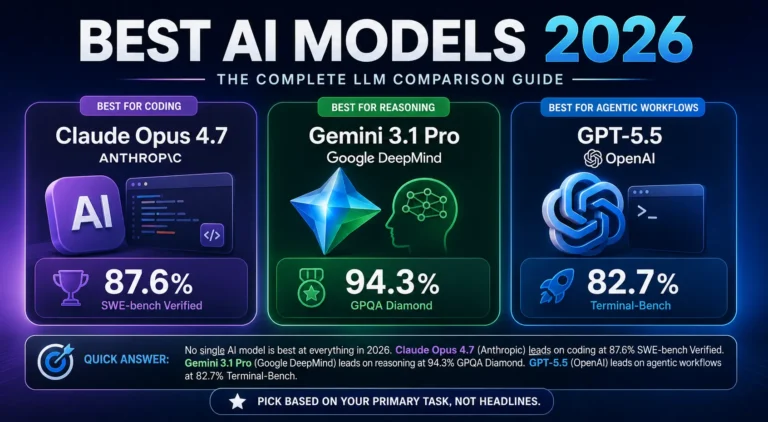
For a full breakdown of how both models compare against Claude and other frontier LLMs, see our complete LLM comparison guide for 2026.
Get the daily AI brief
Delivered at 7:30 AM EST, Monday to Friday. The signal without the noise. Free. No fluff. Unsubscribe anytime.