
ChatGPT Prompts for Small Business: 25 Practical Workflows
ChatGPT prompts for small business work best when they define a clear goal, include real business context, and specify what a useful output should look like. The 25 templates below cover marketing, customer service, sales, operations, finance, and planning. Replace the bracketed fields, remove sensitive information, and review every result before using it with customers or employees.
Quick answer: what makes a useful small-business prompt?
Use three parts: goal, context, and output. State the job to be done, provide the facts ChatGPT needs, and define the format, tone, length, and constraints. For important work, ask the model to identify missing information and assumptions before it drafts the final answer.
| Prompt element | What to include | Example |
|---|---|---|
| Goal | The business task and desired decision | Draft a follow-up email that earns a reply |
| Context | Audience, offer, evidence, limits, and source material | Local service business; quote sent three days ago |
| Output | Format, length, tone, and approval criteria | Under 120 words; professional; one clear next step |
This structure follows current OpenAI guidance to be clear and specific, provide relevant context, define the desired format, and improve the prompt iteratively. You do not need elaborate prompt-engineering jargon. A precise business request usually works better than a vague command.
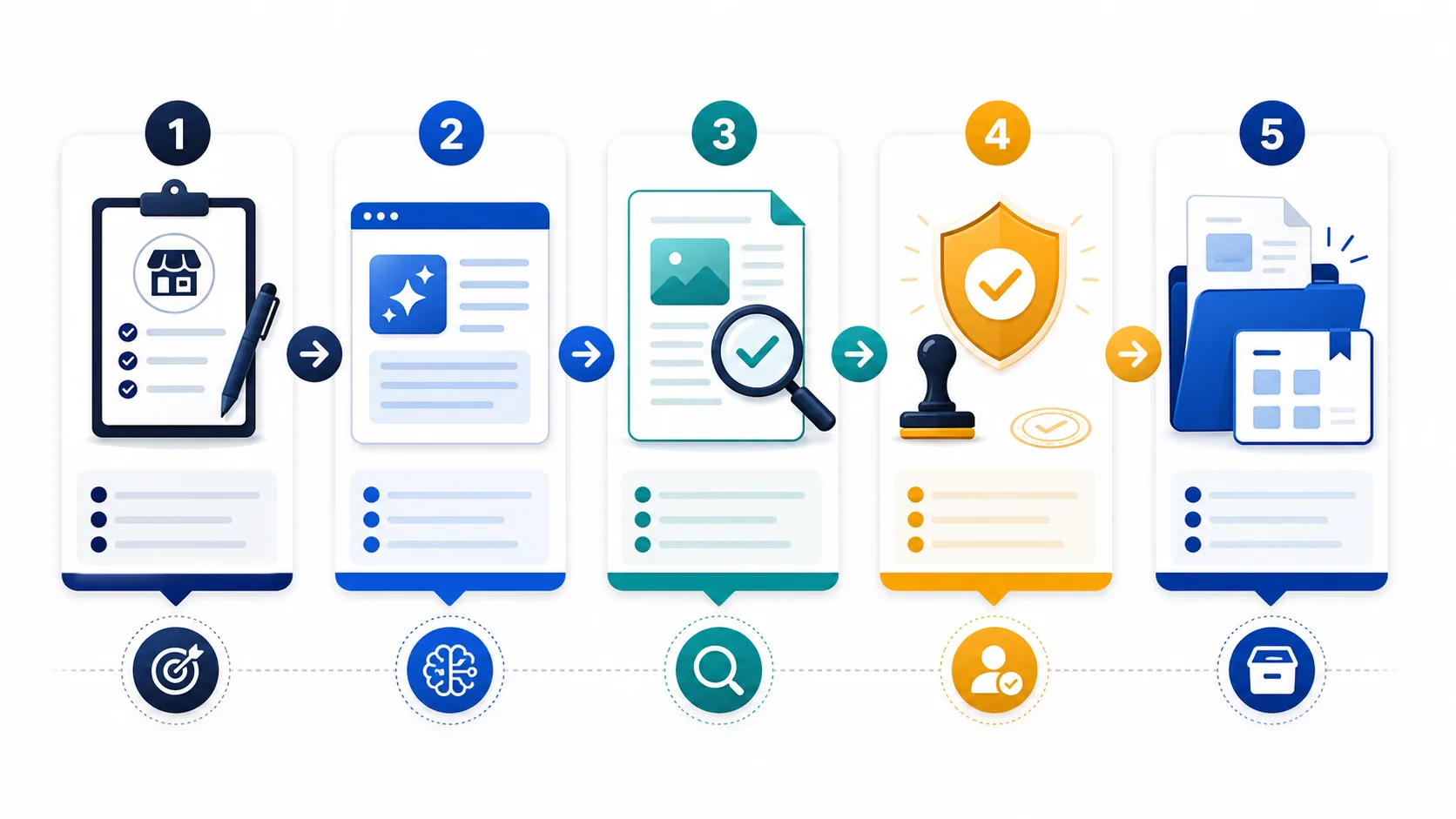
How to use these ChatGPT prompts for small business
- Copy one prompt and replace every field in square brackets.
- Paste only the information required for that task. Remove passwords, payment details, private customer data, employee records, and confidential contracts.
- Ask ChatGPT to list missing information and assumptions before creating the final output.
- Review names, dates, prices, policies, calculations, and claims against the original source.
- Save the approved version as a repeatable workflow for your team.
If you are still choosing a tool stack, start with our best AI tools for small business guide. For larger multi-step projects, compare these templates with ChatGPT Work.
The ChatGPT prompts for small business below are grouped by task so you can begin with the workflow that currently consumes the most time.
Marketing prompts
1. Build a one-month content calendar
You are helping [BUSINESS NAME], a [BUSINESS TYPE] serving [AUDIENCE] in [LOCATION OR MARKET]. Our main offer is [OFFER], and our customers usually choose us because [DIFFERENTIATOR].

Create a four-week content calendar with three posts per week. Balance educational, trust-building, and promotional content. For each post, provide: channel, topic, hook, key message, call to action, and one visual idea. Do not invent customer results or statistics. First list any information you still need and state your assumptions.
Review: Confirm that every offer, date, and proof point is real. Use the calendar as a plan, not as twelve automatic posts.
2. Turn one offer into three channel-specific posts
Adapt the offer below into three original posts for [LINKEDIN / INSTAGRAM / FACEBOOK].

Offer: [PASTE VERIFIED OFFER DETAILS]
Audience: [AUDIENCE]
Brand voice: [3 ADJECTIVES]

For each channel, write a platform-appropriate hook, body, and call to action. Keep every claim supported by the offer details. Avoid generic hype, false urgency, and repeated wording across channels.
3. Create five value propositions
Help me clarify the value proposition for [PRODUCT OR SERVICE]. Our ideal customer is [CUSTOMER], their main problem is [PROBLEM], and our verified advantages are [ADVANTAGES].

Write five value-proposition options. Each must be one sentence, specific, credible, and easy to understand. Then score each option from 1 to 5 for clarity, relevance, differentiation, and believability. Recommend the strongest option and explain the tradeoff.
4. Draft a local promotion without false urgency
Draft a local promotion for [BUSINESS] in [LOCATION]. The verified offer is [OFFER], valid from [START DATE] through [END DATE], with these conditions: [CONDITIONS].

Create: one email subject line, one 100-word email, one 60-word social post, and one in-store sign headline. Use a friendly, direct tone. State the dates and conditions clearly. Do not add scarcity, discounts, guarantees, or urgency that I did not provide.
5. Create an SEO content brief
Create an SEO content brief for the search query [QUERY]. Our audience is [AUDIENCE], and our business has first-hand experience with [EXPERIENCE].

Define the likely search intent, the reader's main questions, a useful H2/H3 outline, evidence we should gather, internal pages we should link, and claims that require authoritative sources. Flag any topic that could overlap an existing page listed below.

Existing pages: [PASTE TITLES AND URLS]

Do not write the article yet.
For more marketing-specific options, see our comparison of the best AI tools for marketing.
Customer service prompts
6. Draft a response to an unhappy customer
Draft a customer-service response to the message below.

Customer message: [PASTE MESSAGE AFTER REMOVING PERSONAL DATA]
Verified facts: [FACTS]
Our policy: [POLICY]
Available resolution options: [OPTIONS]

Use a calm, respectful tone. Acknowledge the specific concern without admitting facts we cannot verify. Explain the next step clearly. Keep the response under 180 words. Do not promise a refund, deadline, or outcome outside the listed options.
7. Turn recurring questions into an FAQ
Use the questions below to create a customer FAQ for [BUSINESS]. Group duplicate questions, preserve important differences, and answer only from the verified information provided.

Questions: [PASTE QUESTIONS]
Verified policies and product information: [PASTE SOURCE MATERIAL]

Return 8 to 12 questions with concise answers. Add a label of "Needs confirmation" wherever the source material does not support a reliable answer.
8. Create a support triage checklist
Create a support triage checklist for [BUSINESS TYPE]. Incoming requests include [REQUEST TYPES]. Our escalation rules are [RULES].

Build a simple decision process with four fields: category, information to collect, safe first response, and escalation trigger. Never request a password, full payment-card number, or unnecessary sensitive information. Flag emergencies and legal, financial, medical, or security issues for qualified human review.
9. Improve a customer email without changing the facts
Edit the email below for clarity and tone without changing its facts, prices, dates, commitments, or policy meaning.

Audience: [AUDIENCE]
Desired tone: [TONE]
Maximum length: [LENGTH]
Draft: [PASTE DRAFT]

Return the revised email, followed by a short list of material changes. Flag any sentence that may create an unintended promise.
10. Summarize customer feedback into actions
Analyze the anonymized customer feedback below. Do not infer demographics or facts that are not present.

Feedback: [PASTE ANONYMIZED FEEDBACK]

Identify recurring themes, the strongest positive signal, the most urgent friction point, and five possible actions. For each action, show supporting feedback, expected benefit, effort level, and a simple measurement. Separate observations from hypotheses.
Sales prompts
11. Prepare discovery questions
Prepare 12 discovery questions for a first conversation with a potential [CUSTOMER TYPE] considering [OFFER]. The goal is to understand fit, priorities, current process, decision criteria, budget range, timeline, and risks without pressuring the prospect.

Order the questions naturally. For each question, explain what a useful answer would help us decide. Do not include manipulative closing tactics.
12. Draft a proposal outline
Create a proposal outline based only on the verified notes below.

Prospect goal: [GOAL]
Current problem: [PROBLEM]
Scope discussed: [SCOPE]
Constraints: [CONSTRAINTS]
Price and terms: [VERIFIED PRICE AND TERMS]

Use these sections: executive summary, objectives, scope, deliverables, client responsibilities, timeline, price, assumptions, exclusions, and next step. Mark missing information clearly instead of inventing it.
13. Write a respectful follow-up
Write a follow-up email for a prospect who received [QUOTE / DEMO / PROPOSAL] on [DATE]. The prospect cared most about [PRIORITY]. The agreed next step was [NEXT STEP].

Keep the email under 120 words. Reference the prospect's priority, answer no questions that were not actually discussed, and offer one easy next action. Use a professional, low-pressure tone.
14. Compare two offers transparently
Build a neutral comparison between our offer and an alternative using only the facts below.

Our offer: [VERIFIED DETAILS]
Alternative: [VERIFIED DETAILS]
Customer priorities: [PRIORITIES]

Create a table covering fit, price, setup, support, limitations, and best use case. Identify where information is missing. Recommend our offer only when the stated priorities support that conclusion.
Operations prompts
15. Turn a repeated task into an SOP
Convert the process notes below into a standard operating procedure for [TASK].

Process notes: [PASTE NOTES]
Responsible role: [ROLE]
Tools used: [TOOLS]
Approval points: [APPROVALS]

Return: purpose, trigger, required inputs, numbered steps, quality checks, exceptions, escalation path, and completion record. Flag unclear or unsafe steps and ask questions before finalizing.
16. Create a weekly owner dashboard
Design a one-page weekly dashboard for a [BUSINESS TYPE]. The decisions we make weekly are [DECISIONS]. Available data includes [DATA].

Recommend no more than 10 metrics. For each metric, define its purpose, formula, data source, review frequency, and action threshold. Separate leading indicators from lagging indicators. Do not invent benchmark targets; mark them for the owner to set.
17. Plan a project with owners and dependencies
Turn this project goal into an execution plan.

Goal: [GOAL]
Deadline: [DATE]
Team and capacity: [PEOPLE AND AVAILABLE TIME]
Constraints: [CONSTRAINTS]

Create milestones, tasks, owners, dependencies, acceptance criteria, and the three largest risks. Put the result in a table. Highlight any deadline that appears unrealistic and explain why.
18. Build a vendor evaluation scorecard
Create a vendor evaluation scorecard for [PRODUCT OR SERVICE CATEGORY]. Our required capabilities are [REQUIREMENTS], budget is [BUDGET], and major risks are [RISKS].

Propose weighted criteria totaling 100%. Include functionality, total cost, implementation, support, security/privacy, contract flexibility, and exit risk when relevant. Add evidence required for each score. Do not score vendors without evidence.
19. Run a pre-mortem
Run a pre-mortem for this plan: [PLAN]. Assume it failed six months from now.

List 10 plausible failure causes across demand, cash flow, operations, staffing, technology, compliance, and execution. For each cause, provide an early warning sign, prevention step, contingency, and owner. Rank by likelihood and impact, and separate evidence-based risks from speculation.
Finance and administration prompts
20. Explain a cash-flow variance
Analyze the cash-flow summary below. The data is anonymized and contains no account numbers.

Expected: [EXPECTED FIGURES]
Actual: [ACTUAL FIGURES]
Known events: [EVENTS]

Calculate the main variances, identify possible drivers, and list questions for the bookkeeper. Separate calculations from hypotheses. Do not provide tax, accounting, or investment advice, and do not treat an unexplained difference as an error or fraud.
21. Create a simple budget scenario table
Create three budget scenarios for the next [PERIOD]: conservative, base, and growth.

Starting revenue: [REVENUE]
Fixed costs: [FIXED COSTS]
Variable-cost assumptions: [ASSUMPTIONS]
Planned investments: [INVESTMENTS]

Show every formula and assumption. Return a table with revenue, gross margin, operating costs, cash impact, and break-even point. Flag inputs that need verification by a qualified financial professional.
22. Summarize a contract for review
Summarize the contract text below for business review. This is not a request for legal advice.

Contract: [PASTE ONLY NON-SENSITIVE TEXT]

Extract parties, term, renewal, payment, deliverables, termination, liability, confidentiality, data use, and dispute provisions. Quote the relevant section number for each point. List missing or ambiguous terms and questions for a qualified attorney. Do not state that a clause is legally enforceable or safe.
Planning and team prompts
23. Plan the next 90 days
Help me create a 90-day plan for [BUSINESS]. Our current position is [BASELINE], primary goal is [GOAL], available resources are [RESOURCES], and constraints are [CONSTRAINTS].

Propose no more than three priorities. For each, define a measurable outcome, weekly actions, owner, leading indicator, lagging indicator, and stop-or-adjust rule. Identify what we should deliberately not do during this period.
24. Draft a role scorecard
Create a role scorecard for [ROLE TITLE] at a [BUSINESS TYPE]. The role exists to [PURPOSE] and will own [RESPONSIBILITIES].

Define mission, five measurable outcomes, recurring responsibilities, required skills, decision rights, collaboration points, and a 30/60/90-day onboarding outline. Avoid requirements unrelated to performance. Flag employment-law or compensation decisions for qualified local review.
25. Turn a successful prompt into a reusable team template
Convert the successful prompt and approved output below into a reusable team workflow.

Original prompt: [PROMPT]
Approved output: [OUTPUT]
What made it useful: [NOTES]

Create a template with required inputs, optional inputs, instructions, output format, quality checklist, prohibited data, approval owner, and examples of acceptable and unacceptable results. Keep all business-specific facts as editable placeholders.
Teams that standardize writing work may also benefit from our guide to the best AI writing tools for small business. For the wider software landscape, use the complete AI tools guide.
A five-step safety and quality check
- Source check: Are the prices, dates, policies, names, and product claims supported by current records?
- Privacy check: Did you remove personal, payment, employee, health, legal, and confidential information that the task does not require?
- Promise check: Does the draft accidentally guarantee a result, refund, delivery date, or policy exception?
- Bias check: Is a hiring, customer, or vendor recommendation based on relevant evidence rather than inferred personal characteristics?
- Approval check: Has the responsible person reviewed the final version before it affects a customer, employee, payment, contract, or public claim?
ChatGPT is most useful here as a drafting and structuring tool. It does not replace your records, business judgment, professional advice, or final approval.
Frequently asked questions
What are the best ChatGPT prompts for small business?
The best prompts solve a repeated business task and include the facts needed to complete it. A useful template names the goal, supplies relevant context, defines the output, and includes a review step. Start with a weekly task that already has a clear owner and quality standard.
Can a small business use ChatGPT for customer service?
Yes, ChatGPT can help draft responses, organize FAQs, and create triage checklists. A person should verify policy details, promises, refunds, and sensitive situations before anything is sent to a customer.
Should I paste customer or employee data into ChatGPT?
Use only the minimum information required and remove unnecessary personal or confidential details. Follow your company policy, contractual obligations, applicable law, and the data controls of the ChatGPT plan your organization uses.
How can I improve a weak ChatGPT response?
Identify what is missing: business context, source material, output format, decision criteria, or an example. Add that information in a follow-up prompt, ask the model to state assumptions, and compare the revision with your original records.
Can I automate these prompts?
Automate only after the workflow has produced reliable drafts under human review. Keep approval gates for customer messages, public claims, contracts, payments, employment decisions, and other high-impact actions.
Final recommendation
Choose three of these ChatGPT prompts for small business and test them on real, low-risk work this week. Measure whether they reduce drafting time without increasing corrections. Once a prompt produces consistently useful results, save it as a controlled team template with required inputs, a quality checklist, and a named approver.
Sources and fact-checking
- OpenAI Help Center: Prompt engineering best practices for ChatGPT
- OpenAI Help Center: How do I create a good prompt for an AI model?
- OpenAI Academy: Small Business Prompt Pack
- OpenAI Academy: Small business resource hub
Fact checked and updated on July 27, 2026. AI product features, limits, pricing, and availability can change by plan and region. Always verify important claims in the original source before publishing or making business decisions.